
A Century Ago, Scottish Inventor John Logie Baird Transmitted First Television Image
Key Takeaways
- Scottish inventor John Logie Baird successfully transmitted the first moving human image on Oct. 2, 1925.
- Twenty-year-old office clerk William Taynton served as the world's first televised human subject.
- Baird's equipment was constructed from discarded materials including biscuit tins, tea chests, and bicycle lamp lenses.
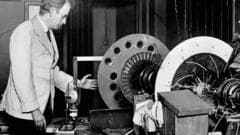
OPA WIRE, Nov 9 (OPA) — On Oct. 2, 1925, Baird used a high-speed spinning disc and intense light to scan and transmit images inside his Soho apartment at 22 Frith Street. Having previously experimented with artificial diamond creation and homemade medical treatments that caused local power outages, the eccentric inventor turned his attention to visual transmission. His crude mechanical apparatus generated extreme heat, transforming the laboratory into a sweltering environment that would have defied modern workplace safety standards.
William Taynton, a 20-year-old office clerk working in the building, became the world's first television star when Baird drafted him into the makeshift studio. Recalling the moment decades later for the BBC, Taynton described dodging hanging wires and old batteries to sit in front of the blinding transmitter. "The equipment he used at that time was dreadful," Taynton said, noting the cardboard discs fitted with bicycle lamp lenses and antiquated motors.
Baird paid the young clerk a half-crown coin—two shillings and sixpence—as television's first wage to convince him to endure the scorching heat. Urged to stick out his tongue and make grimaces to generate motion, Taynton shouted that he was being "roasted alive" before stepping out of the focus area after barely a minute. Despite the primitive conditions and blurry, stamp-sized 5-by-8-centimeter picture, Baird rushed to the receiver shouting that he had captured the first real television image.
Baird's breakthrough bridged decades of theoretical work by 19th-century scientists, realizing the dream of mechanical television through sheer persistence and discarded household items. While the initial fuzzy shapes bore little resemblance to modern high-definition broadcasts, the makeshift setup in Soho laid the foundation for the global television industry that would transform entertainment and news dissemination worldwide.
Subscribe to the Global Briefing
Receive our flagship executive dispatch every morning. Essential geopolitical analysis, financial benchmarks, and breaking world events delivered to your inbox.
Mohammad Karamali
Verified Wire ContributorSenior correspondent covering geopolitics, regional developments, and strategic international affairs for OPA News (Optimum Public Affairs).
Related Stories & Follow-ups
Editorial Wire Culture & Arts
Bestselling Author and Former Conservative Politician Jeffrey Archer Dies at 86
 Culture & Arts
Dave Chappelle Faces Backlash Over Remarks on Charlie Kirk's Death
 Culture & Arts
Breaking Bad Star RJ Mitte Died by Hanging, Inquest Report Reveals
Reader Discussion
Leave a Comment
0 Comments
Owner
Editorial Oversight & Machine-Assisted Reporting
Human-in-the-Loop VerifiedEditorial Oversight & Machine-Assisted Reporting: This dispatch was synthesized and localized via OPA automated intelligence under continuous human editorial supervision.
Wire Source
This report was synthesized from BBC Persian under journalistic fair use.