
Okinawa Celebrates Restored Shuri Castle Main Hall Seven Years After Devastating Fire
Key Takeaways
- Shuri Castle's main hall was officially reopened on Sunday, seven years after a devastating fire on Oct. 31, 2019.
- The restoration utilized historical documents and a newly recreated red pigment derived from iron bacteria found in northern Okinawa.
- The castle is a key cultural heritage symbol of the Ryukyu Kingdom and represents Okinawa's resilience following World War II.
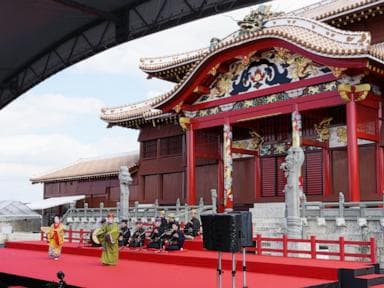
OPA WIRE, Nov 23 (OPA) — Officials and residents in Okinawa celebrated the restoration of Shuri Castle's main hall on Sunday, its deep red exterior and dragon ornaments marking the return of a symbol of the island's heritage seven years after it was destroyed in a blaze. The fire on Oct. 31, 2019, destroyed several buildings at the castle complex in Naha during a local festival. Firefighters battled the flames for nearly 12 hours amid strong winds. Investigators were unable to determine an exact cause, though an electrical fault was considered the likeliest explanation.
"The fire was a tremendous shock to the Okinawan people," Okinawa Gov. Genta Koja said at Sunday's ceremony in the courtyard outside the main hall. "Seven years after the major loss, as we mark this milestone of the main hall restoration, I am deeply moved and delighted." Koja thanked historians, artisans, and experts from across Japan who contributed to the restoration, alongside donors globally. He noted that opening the Seiden is not the final step, calling for the reconstruction of the remaining castle structures.
The castle serves as a central symbol of Okinawa’s cultural heritage dating back to the Ryukyu Kingdom, which lasted approximately 450 years from 1429 until Japan annexed the island in 1879. The site also represents Okinawa’s recovery from World War II, having previously burned down in 1945 during the Battle of Okinawa, which claimed about 200,000 lives. Following that loss, the castle was largely restored in 1992 to commemorate the 20th anniversary of Okinawa's reversion to Japan following the end of the 27-year U.S. occupation.
Historian Kurayoshi Takara, who led the latest restoration effort, stated that the main hall was reproduced to more closely resemble the original building based on historical documents and new findings. Artisans recreated the deeper red pigment by blending iron bacteria found in northern Okinawa with a commercial product after lengthy experiments. While the main hall opens to the public on Monday, experts note that restoring the remaining parts of the castle will take more than a decade. Reconstruction of the major tourist attraction also raises hopes for boosting tourism and regional economic growth.
Subscribe to the Global Briefing
Receive our flagship executive dispatch every morning. Essential geopolitical analysis, financial benchmarks, and breaking world events delivered to your inbox.
Mohammad Karamali
Verified Wire ContributorSenior correspondent covering geopolitics, regional developments, and strategic international affairs for OPA News (Optimum Public Affairs).
Related Stories & Follow-ups
Editorial Wire Culture & Arts
Bestselling Author and Former Conservative Politician Jeffrey Archer Dies at 86
 Culture & Arts
Grand Theft Auto VI Launches Worldwide Following 13-Year Wait
 Culture & Arts
RAYE and Rosalía Lead 2027 Grammy Nominations with Record-Breaking Hauls
Reader Discussion
Leave a Comment
0 Comments
Owner
Editorial Oversight & Machine-Assisted Reporting
Human-in-the-Loop VerifiedEditorial Oversight & Machine-Assisted Reporting: This dispatch was synthesized and localized via OPA automated intelligence under continuous human editorial supervision.
Wire Source
This report was synthesized from ABC under journalistic fair use.