
IMF Warns UK Government Against Excessive Spending Amid Economic Growth Downgrade
Key Takeaways
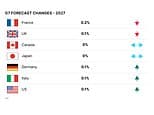
- IMF downgraded UK's 2027 growth forecast from 1.3% to 1.2%.
- The Fund warned against broad-based subsidies and tax cuts to preserve fiscal buffers.
- The UK faces a projected £35 billion black hole in public finances.
The International Monetary Fund (IMF) has issued a stern warning to the UK government, urging Chancellor John Healey to avoid costly, broad-based cost-of-living support measures in the upcoming Budget. In its latest World Economic Outlook, the IMF emphasized that advanced economies must prioritize rebuilding public finances rather than relying on unsustainable fiscal interventions. The Fund cautioned that governments currently possess significantly less room to maneuver than in previous years, as rising borrowing costs and elevated debt levels leave nations vulnerable to future shocks.
Britain’s economic outlook faced a notable downgrade, with the IMF cutting its 2027 growth forecast from 1.3% to 1.2%. The UK and France were the only G7 nations to see their growth projections reduced, highlighting a challenging period for the Chancellor. The IMF explicitly advised against generalized tax cuts, fuel subsidies, and price controls, labeling them as poorly targeted and fiscally damaging. With the Institute for Fiscal Studies estimating a £35 billion black hole in public finances, the IMF’s call for belt-tightening adds significant pressure on the Labour government to address the ballooning welfare bill.
This fiscal warning arrives as the UK faces persistent economic headwinds, including surging energy bills expected to exceed £2,000 in the New Year. While Britain’s 2024 growth forecast was slightly upgraded to 1.3%, the nation continues to lag behind the United States, which is projected to see 2.3% growth driven by AI investment. The IMF noted that Britain’s fiscal buffers, intended to address long-term challenges like climate change and an aging population, have been largely exhausted by repeated economic shocks.
Looking ahead, the Bank of England faces mounting pressure to raise interest rates from 3.75% to 4% by year-end to combat inflation, which is expected to remain elevated at 3.3% in 2026. Unemployment is projected to stagnate at 5.3% through next year. As the Chancellor prepares his fiscal strategy, he must balance the need for public support with the IMF’s demand for a 'credible' Budget that avoids further bond market turmoil and ensures long-term economic stability.
Subscribe to the Global Briefing
Receive our flagship executive dispatch every morning. Essential geopolitical analysis, financial benchmarks, and breaking world events delivered to your inbox.
Related Stories & Follow-ups
Editorial WireBrent Crude Hits Five-Month High Amid Escalating Middle East Tensions
Saudi Aramco Facilities Targeted in Suspected Houthi Drone Strike
Global Travel Disruptions Follow Houthi Drone and Missile Strikes on Riyadh Airport
Reader Discussion
Leave a Comment
0 Comments
Owner
Editorial Oversight & Machine-Assisted Reporting
Human-in-the-Loop VerifiedEditorial Oversight & Machine-Assisted Reporting: This dispatch was synthesized and localized via OPA automated intelligence under continuous human editorial supervision.
Wire Source
This report was synthesized from Daily Mail under journalistic fair use.