
IMF Upgrades Global Growth Forecast Amidst AI Boom and Energy Market Volatility
Key Takeaways
- Global growth forecast upgraded to 3.1% for the year, though long-term outlook remains sluggish.
- AI-driven growth is highly concentrated, with the US and China accounting for 75% of related import demand.
- IMF warns that 40% of global jobs are at risk of being impacted by AI-driven labor market shifts.
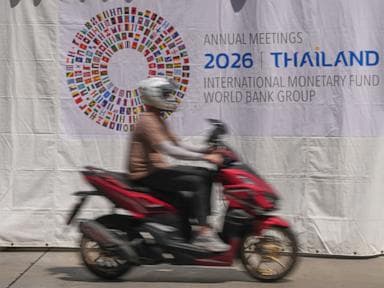
The International Monetary Fund has slightly upgraded its global economic growth forecast for the year to 3.1%, up from a previous 3.0% estimate. Despite this marginal improvement, the outlook remains sluggish compared to the 3.5% expansion observed in 2025. As financial leaders convene in Bangkok, the IMF highlights a starkly uneven economic landscape where growth is increasingly concentrated; currently, just 32 nations account for 95% of global expansion, a significant decline from the 54 countries reported in April.
Economic performance is being reshaped by two primary forces: the rapid adoption of artificial intelligence and severe energy supply shocks. While AI demand is providing a critical buffer, its benefits are heavily skewed, with the United States and China driving over 75% of net demand for AI-related imports. IMF Director of Research Silvana Tenreyro noted that growth is being reallocated based on exposure to war-induced supply disruptions and technological integration, warning that the global economy is experiencing a complex shift rather than a uniform acceleration.
Labor markets face profound uncertainty as AI integration accelerates. IMF Managing Director Kristalina Georgieva characterized the technological shift as a "slow-moving tsunami," estimating that approximately 40% of global jobs could be augmented, downgraded, or eliminated over time. Furthermore, the IMF has raised concerns regarding mounting national debt levels exacerbated by high borrowing costs, urging both developed and emerging economies to prioritize fiscal stability to mitigate the risk of a broader financial crisis.
Looking ahead, the IMF anticipates a cooling period by 2027, with advanced economies expected to slow to 1.9% growth next year. Emerging markets, currently struggling with energy costs, are projected to see growth dip to 3.7% this year before rebounding to 4.4% in 2027. The forecast assumes a normalization of energy shipments through the Strait of Hormuz by March and a moderation in AI demand. Meanwhile, India remains the fastest-growing major economy at 7%, while China’s expansion is expected to settle at 4.5%.
Reader Discussion
Leave a Comment
0 Comments
Owner
Editorial Oversight & Machine-Assisted Reporting
Human-in-the-Loop VerifiedEditorial Oversight & Machine-Assisted Reporting: This dispatch was synthesized and localized via OPA automated intelligence under continuous human editorial supervision.
Wire Source
This report was synthesized from ABC under journalistic fair use.