
French Government Struggles to Address Student Protests Amid Severe Budget Cuts
Key Takeaways
- Nationwide student protests demand education reforms while France seeks €54 billion in public spending cuts.
- Rising yields will push annual debt interest payments to an estimated €74 billion, eclipsing national education and defense spending.
- Lacking a parliamentary majority, the government faces major gridlock over the austerity budget ahead of the 2027 presidential elections.
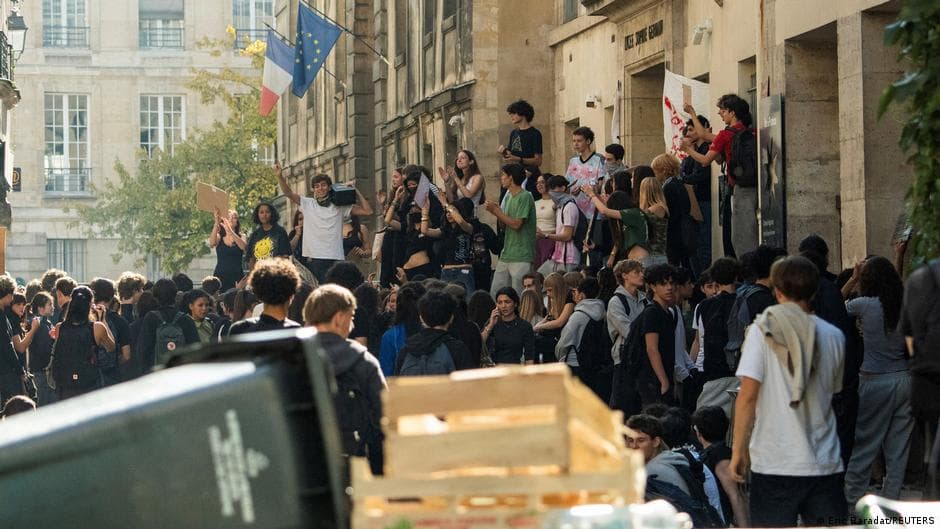
France's government under Prime Minister Sebastien Lecornu is struggling to manage nationwide student protests while implementing broad spending cuts. For nearly two weeks, students have mobilized against recurring class cancellations, overcrowded classrooms, deteriorating infrastructure, and the contentious Parcoursup university admissions platform. Tension escalated into police clashes and school blockades, prompting the administration to accuse the left-wing opposition party La France Insoumise of exploiting the unrest. In response, Lecornu instructed ministers to present rapid proposals to improve school conditions and reform university admissions this month.
The unrest coincides with severe fiscal tightening as Paris attempts to curb its public deficit under the European Union’s excessive deficit procedure. The government submitted a draft budget aiming to lower the deficit from 5.4 percent of economic output to 5 percent by cutting €54 billion ($60.8 billion) in state spending. Pensions alone are targeted for €5.5 billion in cuts, alongside reductions in healthcare. "It is an austerity budget," noted Eileen Keller of the Franco-German Institute, emphasizing that the draft serves primarily to reassure jittery financial markets that the administration is curbing borrowing.
Escalating debt service costs are severely limiting French fiscal policy. France’s public debt stands near 119 percent of GDP, almost double that of Germany. As low-interest debt matures, rising yields have pushed the French-German 10-year bond spread to 1.5 percentage points—its widest since the eurozone crisis. By 2027, annual interest payments are projected to reach €74 billion, outpacing expenditures on defense or schools. Although the education budget is set to rise by €1.2 billion, systemic dissatisfaction persists alongside shifting student demographics.
Passing the fiscal package poses a steep political challenge since the Lecornu administration lacks an absolute majority in parliament. With presidential elections approaching in spring 2027, opposition lawmakers remain reluctant to endorse painful austerity measures. Analysts warn that financial markets are closely monitoring the campaign for signs of fiscal consolidation, with estimates placing total necessary deficit reductions between €75 billion and €160 billion. Without cross-party consensus, mounting social protests and parliamentary deadlock threaten to deepen market skepticism and prolong domestic turmoil.
Subscribe to the Global Briefing
Receive our flagship executive dispatch every morning. Essential geopolitical analysis, financial benchmarks, and breaking world events delivered to your inbox.
Related Stories & Follow-ups
Editorial WireTrump Waives New Russia Sanctions, Drawing Sharp Criticism from Zelenskyy
 Politics
Zelenskyy Urges Sanctions Enforcement After Trump Pauses Measures Against Russia
 Politics
Violent Protests Erupt Across France Over Rising Living Costs and Student Grievances
Reader Discussion
Leave a Comment
0 Comments
Owner
Editorial Oversight & Machine-Assisted Reporting
Human-in-the-Loop VerifiedEditorial Oversight & Machine-Assisted Reporting: This dispatch was synthesized and localized via OPA automated intelligence under continuous human editorial supervision.
Wire Source
This report was synthesized from DW English under journalistic fair use.