
Neanderthal Wooden Tools Preserved in Spanish Stone Reveal Advanced Daily Life
Key Takeaways
- Spanish archaeologists cataloged 597 wooden remains preserved as travertine molds dating back up to 62,000 years.
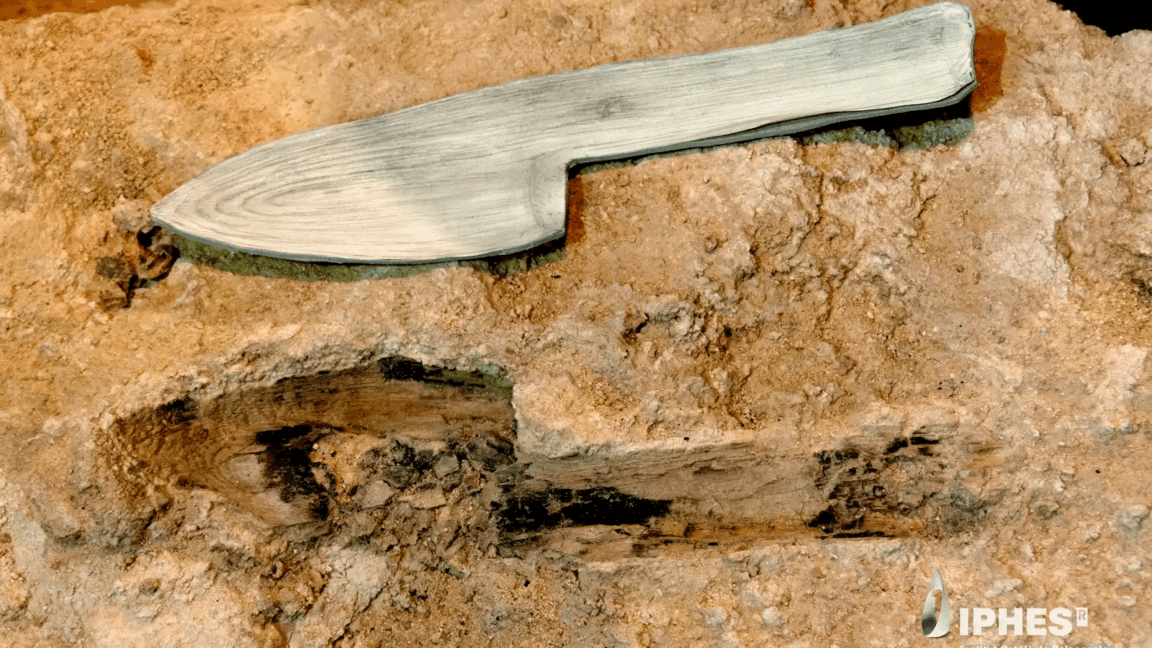
- Artifacts include bark trays, structural poles, spears, and a distinct single-piece carved wooden club.
- Researchers utilized 3D scanning and printing to recreate the hollow stone negatives left by decayed organic matter.
OPA WIRE, Oct 10 (OPA) — Archaeologists excavating the Abric Romaní rock shelter in Capellades, Spain, have uncovered exceptionally preserved limestone molds of Neanderthal wooden tools dating from 62,000 to 40,000 years ago. A study published in Science Advances details how mineral-rich water encrusted the artifacts before the organic material rotted away, preserving precise hollow negatives. The discoveries challenge long-held assumptions regarding Neanderthal cognitive and technological limitations, demonstrating that woodworking was integral to their domestic and hunting routines.
The cataloged inventory includes 597 wooden remnants, with 13 distinct modified artifacts including digging sticks, juniper-bark trays, hunting spears, and a uniquely shaped club carved from a single piece of wood. “We have a sample of wooden tools for different subsistence activities, not only hunting,” stated co-author M. Gema Chacón from the Catalan Institute of Human Paleoecology and Social Evolution. Chacón noted that the 2.45-meter spear displayed impact fractures consistent with striking bone, while the 14-centimeter triangular club head represents an unprecedented Paleolithic design.
Historically, the vast majority of surviving Paleolithic artifacts are stone weapons or waterlogged hunting equipment found in locations like Lehringen, Germany. Unlike those isolated finds, Abric Romaní provides a continuous stratigraphic record of Neanderthal domestic living over approximately 20,000 years. The researchers used 3D scanning, photogrammetry, and 3D printing to reconstruct the negative cavities left in the travertine crust, identifying Scotch pine firewood, structural poles exceeding five meters used for shelter windbreaks, and discrete hearth arrangements used for sleeping and meal preparation.
The findings provide conclusive physical evidence that Neanderthals possessed sophisticated material knowledge and engaged in deliberate, routine woodworking for domestic habitation. The spatial distribution of domestic utensils near hearths indicates systematic social organization and task division within living quarters. Future excavations at the site and advanced digital casting techniques are expected to further illuminate Paleolithic organic technology, bridging critical gaps in our understanding of early hominin culture and technical skill before their extinction.
Subscribe to the Global Briefing
Receive our flagship executive dispatch every morning. Essential geopolitical analysis, financial benchmarks, and breaking world events delivered to your inbox.
Mohammad Karamali
Verified Wire ContributorSenior correspondent covering geopolitics, regional developments, and strategic international affairs for OPA News (Optimum Public Affairs).
Related Stories & Follow-ups
Editorial Wire


Reader Discussion
Leave a Comment
0 Comments
Owner
Editorial Oversight & Machine-Assisted Reporting
Human-in-the-Loop VerifiedEditorial Oversight & Machine-Assisted Reporting: This dispatch was synthesized and localized via OPA automated intelligence under continuous human editorial supervision.
Wire Source
This report was synthesized from Ars Technica under journalistic fair use.