
Archaeologists Discover World's Oldest Known Shipwreck Off Turkish Coast
Key Takeaways
- The shipwreck dates back 4,700 years, making it the oldest ever discovered.
- The 32-foot vessel was carrying over 30 amphorae likely produced in the Jordan Valley.
- The discovery confirms extensive maritime trade networks existed during the Early Bronze Age.
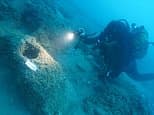
ANKARA, Oct 14 (OPA) — Archaeologists have discovered the world’s oldest known shipwreck off the coast of Kekova Island in Antalya, Turkey. Dating back approximately 4,700 years, the vessel sank between 2600 BC and 2400 BC, placing its origin during the construction of the Great Pyramid of Giza. While the wooden hull has long since decayed, the site remains a significant archaeological find, resting nearly 100 feet (30 meters) below the surface of the Mediterranean Sea.
Led by Professor Hakan Oniz of Akdeniz University, the expedition team identified a cargo consisting of more than 30 ceramic amphorae and three stone anchors. Professor Oniz described the site as a "time capsule at the bottom of the sea." The vessel, estimated to be 32 feet (10 meters) in length, likely served as a trade ship transporting goods such as olive oil or wine. Analysis of the clay suggests the amphorae originated from workshops in the Jordan Valley, indicating sophisticated maritime logistics.
This discovery surpasses the age of the Dokos wreck in Greece, which was previously considered the oldest known shipwreck. The presence of similar ceramic vessels at historical sites in Egypt, Troy, and Crete provides crucial evidence of extensive Bronze Age trade networks. Among the artifacts, one unique amphora featuring nine markings and two holes suggests that ancient sailors may have produced their own food, such as cheese or butter, during long-distance voyages.
Turkey's Culture and Tourism Minister, Mehmet Nuri Ersoy, emphasized that the find sheds new light on Anatolia’s maritime history and the connectivity of ancient civilizations. By mapping these trade routes, researchers hope to gain a deeper understanding of how different regions were linked by sea during the Early Bronze Age. The study, published in the Journal of Maritime Archaeology, confirms the vessel was likely traveling from the Levantine coast toward Troy or Crete when it encountered disaster.
Subscribe to the Global Briefing
Receive our flagship executive dispatch every morning. Essential geopolitical analysis, financial benchmarks, and breaking world events delivered to your inbox.
Mohammad Karamali
Verified Wire ContributorSenior correspondent covering geopolitics, regional developments, and strategic international affairs for OPA News (Optimum Public Affairs).
Related Stories & Follow-ups
Editorial Wire Science
Nobel Prize in Chemistry Awarded to Henri B. Kagan and Kenso Soai
 Science
Nobel Physics Prize Awarded to Francis Halzen for Astrophysical Neutrino Breakthrough
 Science
Colossal Biosciences Unveils AI Platform GenoMorph to Accelerate Dodo De-Extinction Efforts
Reader Discussion
Leave a Comment
0 Comments
Owner
Editorial Oversight & Machine-Assisted Reporting
Human-in-the-Loop VerifiedEditorial Oversight & Machine-Assisted Reporting: This dispatch was synthesized and localized via OPA automated intelligence under continuous human editorial supervision.
Wire Source
This report was synthesized from Daily Mail under journalistic fair use.