
Japan launches £262 million mission to collect samples from Mars moon Phobos
Key Takeaways
- The MMX mission aims to return at least 10g of material from Phobos to Earth by 2031.
- The spacecraft will launch from Japan's Tanegashima Space Centre on an H3 rocket.
- The mission will utilize 13 scientific instruments to analyze the moon's composition and origin.
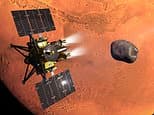
OPA WIRE, Oct 20 (OPA) — The Martian Moons Exploration (MMX) spacecraft is scheduled to launch tonight at 8:41 p.m. BST from the Tanegashima Space Centre aboard an H3 rocket. The mission, valued at £262 million, will travel 300 million miles to reach Phobos, the larger of Mars’s two moons. Upon arrival, the craft will deploy a microwave-sized rover to survey the surface before the main module spends two-and-a-half hours collecting samples using either a drilling system or a nitrogen gas blast mechanism.
JAXA officials stated the mission seeks to clarify the formation of the Martian system and the solar system. The spacecraft carries 13 scientific instruments, including high-resolution cameras, a laser altimeter, and mineral-analysis tools, to map the moon's terrain and chemical composition. The European Space Agency has contributed deep-space communication equipment to support the mission's data transmission requirements.
Scientists intend to use the samples to resolve a long-standing debate regarding whether Phobos is a captured asteroid or the result of a massive collision involving Mars. Because of its proximity to the Red Planet, researchers believe the moon may also contain debris ejected from the Martian surface by historical asteroid impacts. This material could provide insights into the evolution of Mars and its potential for past habitability.
Following the collection phase, the spacecraft will depart the Martian system and return to Earth in 2031. The samples will be contained within a capsule designed to survive atmospheric reentry, landing by parachute in the Australian outback. Once recovered, the material will be transported to Japan for laboratory analysis, where researchers can utilize equipment too complex or sensitive for deployment in space.
Subscribe to the Global Briefing
Receive our flagship executive dispatch every morning. Essential geopolitical analysis, financial benchmarks, and breaking world events delivered to your inbox.
Mohammad Karamali
Verified Wire ContributorSenior correspondent covering geopolitics, regional developments, and strategic international affairs for OPA News (Optimum Public Affairs).
Related Stories & Follow-ups
Editorial Wire Science
Nobel Prize in Chemistry Awarded to Henri B. Kagan and Kenso Soai
 Science
Nobel Physics Prize Awarded to Francis Halzen for Astrophysical Neutrino Breakthrough
 Science
Colossal Biosciences Unveils AI Platform GenoMorph to Accelerate Dodo De-Extinction Efforts
Reader Discussion
Leave a Comment
0 Comments
Owner
Editorial Oversight & Machine-Assisted Reporting
Human-in-the-Loop VerifiedEditorial Oversight & Machine-Assisted Reporting: This dispatch was synthesized and localized via OPA automated intelligence under continuous human editorial supervision.
Wire Source
This report was synthesized from Daily Mail under journalistic fair use.