
ESA spacecraft reveals stadium-sized crater on asteroid struck by NASA
Key Takeaways
- ESA's Hera spacecraft is currently examining the aftermath of NASA's 2022 DART impact on Dimorphos.
- The DART spacecraft struck Dimorphos at 22,000 km/h, reducing its orbital period around Didymos by 33 minutes.
- The impact left Dimorphos tumbling erratically and carved a crater nearly the size of the 150-meter asteroid.
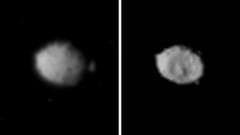
OPA WIRE, Nov 27 (OPA) — The European Space Agency's Hera spacecraft has arrived at the binary asteroid system containing Didymos and Dimorphos to examine the aftermath of NASA's 2022 DART mission impact. Scientists reported that the collision carved a massive crater roughly the size of the 150-meter-wide asteroid itself, fundamentally altering the celestial body's shape and orbital dynamics.
Dr. Sabina Raducan, a planetary scientist on the Hera mission team, described the impact site as a stunning and scientifically unprecedented view. The initial 2022 test involved NASA's DART spacecraft slamming into Dimorphos at 22,000 kilometers per hour, generating a 10,000-kilometer debris trail observed by telescopes across Earth.
Prior to the intentional collision, Dimorphos maintained a regular orbit around the larger 730-meter-wide Didymos once every 11 hours and 55 minutes. The impact successfully shortened its orbital period by approximately 33 minutes and disrupted its rotation, causing the smaller asteroid to tumble erratically like a barrel rolling down stairs.
Data and high-resolution imagery collected by Hera are also capturing detailed surface features of the larger Didymos, where surface gravity is roughly one-forty-thousandth of Earth's. Researchers noted complex geological structures and boulder fields spanning three to ten meters across, providing crucial metrics for future planetary defense frameworks.
Subscribe to the Global Briefing
Receive our flagship executive dispatch every morning. Essential geopolitical analysis, financial benchmarks, and breaking world events delivered to your inbox.
Mohammad Karamali
Verified Wire ContributorSenior correspondent covering geopolitics, regional developments, and strategic international affairs for OPA News (Optimum Public Affairs).
Related Stories & Follow-ups
Editorial Wire

Reader Discussion
Leave a Comment
0 Comments
Owner
Editorial Oversight & Machine-Assisted Reporting
Human-in-the-Loop VerifiedEditorial Oversight & Machine-Assisted Reporting: This dispatch was synthesized and localized via OPA automated intelligence under continuous human editorial supervision.
Wire Source
This report was synthesized from BBC Persian under journalistic fair use.