
SpaceX's Starship achieves orbit and deploys next-gen Starlinks
Key Takeaways
- Starship reached low-Earth orbit for the first time, deploying 26 next-generation Starlink V3 satellites.
- Starlink V3 satellites offer 1 Tbps of capacity, a tenfold increase over older models launched on Falcon 9.
- Despite engine performance issues, SpaceX successfully performed an orbital insertion burn at 171 miles altitude.
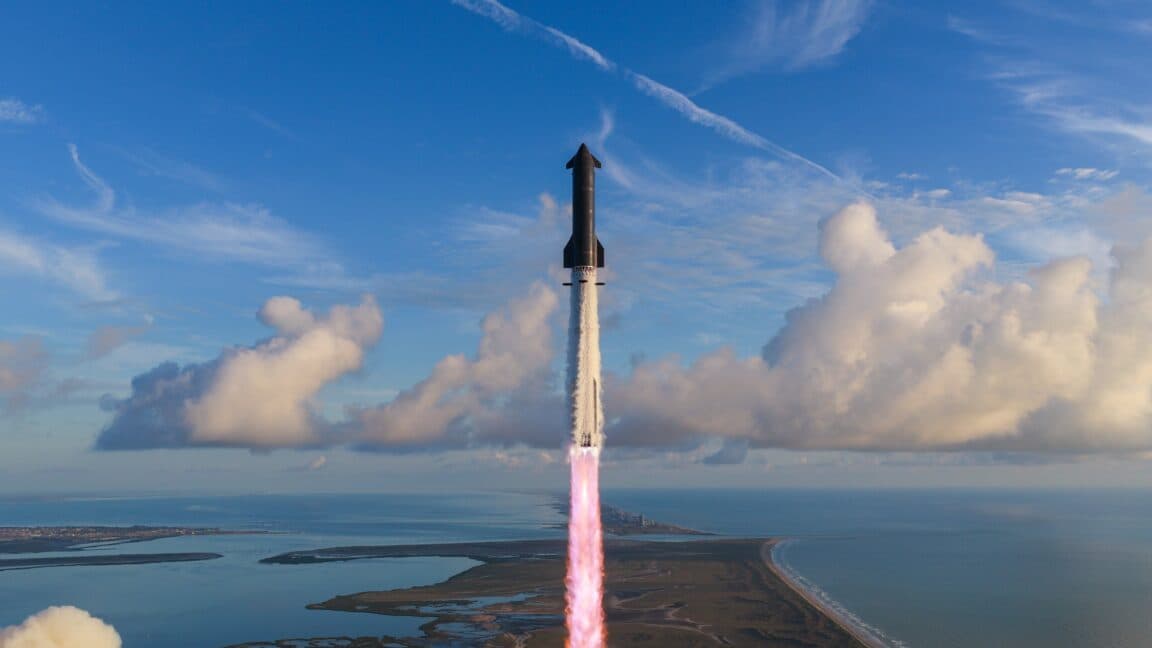
OPA WIRE, Sep 28 (OPA) — SpaceX’s Starship rocket successfully reached low-Earth orbit for the first time during its 14th test flight, marking a historic milestone for the world’s most powerful launch vehicle. Departing from Starbase, Texas, on Monday morning, the massive 407-foot rocket utilized its 33 methane-fueled Raptor engines to pierce the atmosphere. Unlike previous suborbital missions, this flight saw the upper stage accelerate to orbital velocity, effectively completing a full lap around the planet and demonstrating the vehicle's capability to carry heavy payloads into space.
The mission involved the deployment of 26 next-generation Starlink V3 satellites, which were released from the rocket’s cargo bay using a specialized pulley system. Despite a premature shutdown of one Raptor engine during ascent and minor malfunctions in the Super Heavy booster, mission control successfully executed an orbital insertion burn. SpaceX commentator Dan Huot confirmed that the team prioritized safety, ensuring the core systems were robust enough to handle the maneuver, which added approximately 204 mph to the vehicle's speed to reach an altitude of 171 miles.
Historically, SpaceX has utilized its Falcon 9 rockets for satellite deployment, but the Starlink V3 units are too large for the Falcon 9 fairing. These new satellites, weighing 2 metric tons each, feature upgraded solar arrays and antennas designed to provide 1 Tbps of capacity—ten times the performance of older models. The transition to Starship for these launches represents a strategic shift for SpaceX, as the company phases out Falcon 9 for Starlink deployments to accommodate the increased scale and power of its next-generation constellation.
The successful deployment has significant ramifications for global broadband connectivity and the future of space logistics. By increasing the capacity of the Starlink network, SpaceX aims to improve user speeds and expand direct-to-device services, potentially serving military applications like Starshield. However, industry experts like Caleb Henry of Quilty Space note that while the technology is promising, it will require many more successful Starship flights before these V3 satellites become the defining factor in the overall user experience.
Looking ahead, SpaceX plans to integrate these new satellites into the broader network within weeks, though widespread service improvements may take longer to materialize. The company is also expected to move toward higher-inclination orbits as it gains experience and develops new launch pads in Florida and Louisiana. While Monday’s flight concluded with an early de-orbit splashdown due to engine caution, the mission serves as a definitive proof-of-concept for Starship’s role as the primary workhorse for SpaceX’s future orbital operations.
Subscribe to the Global Briefing
Receive our flagship executive dispatch every morning. Essential geopolitical analysis, financial benchmarks, and breaking world events delivered to your inbox.
Mohammad Karamali
Verified Wire ContributorSenior correspondent covering geopolitics, regional developments, and strategic international affairs for OPA News (Optimum Public Affairs).
Related Stories & Follow-ups
Editorial Wire Technology
Global Microsoft Outage Disrupts Critical Services Worldwide as 48-Hour Recovery Begins
 Technology
Nvidia Faces Global Crisis Following Shock Resignation of CEO Jensen Huang
 Technology
Nvidia CEO Jensen Huang Ousted Following Multiple Affairs and Security Scandals
Reader Discussion
Leave a Comment
0 Comments
Owner
Editorial Oversight & Machine-Assisted Reporting
Human-in-the-Loop VerifiedEditorial Oversight & Machine-Assisted Reporting: This dispatch was synthesized and localized via OPA automated intelligence under continuous human editorial supervision.
Wire Source
This report was synthesized from Ars Technica under journalistic fair use.