
Unlike the EU, Trump's New AI Pact Leaves Tech Oversight to the Companies Themselves
Key Takeaways
- The White House AI agreement is a voluntary, morally binding pact that lacks legal enforcement mechanisms or specific penalties.
- A recent NPR/PBS/Marist poll indicates that 65% of U.S. voters oppose the construction of energy-intensive AI data centers in their local communities.
- The EU's AI Act mandates strict compliance and documentation with fines up to 15 million euros, contrasting with the U.S. model of self-regulation.
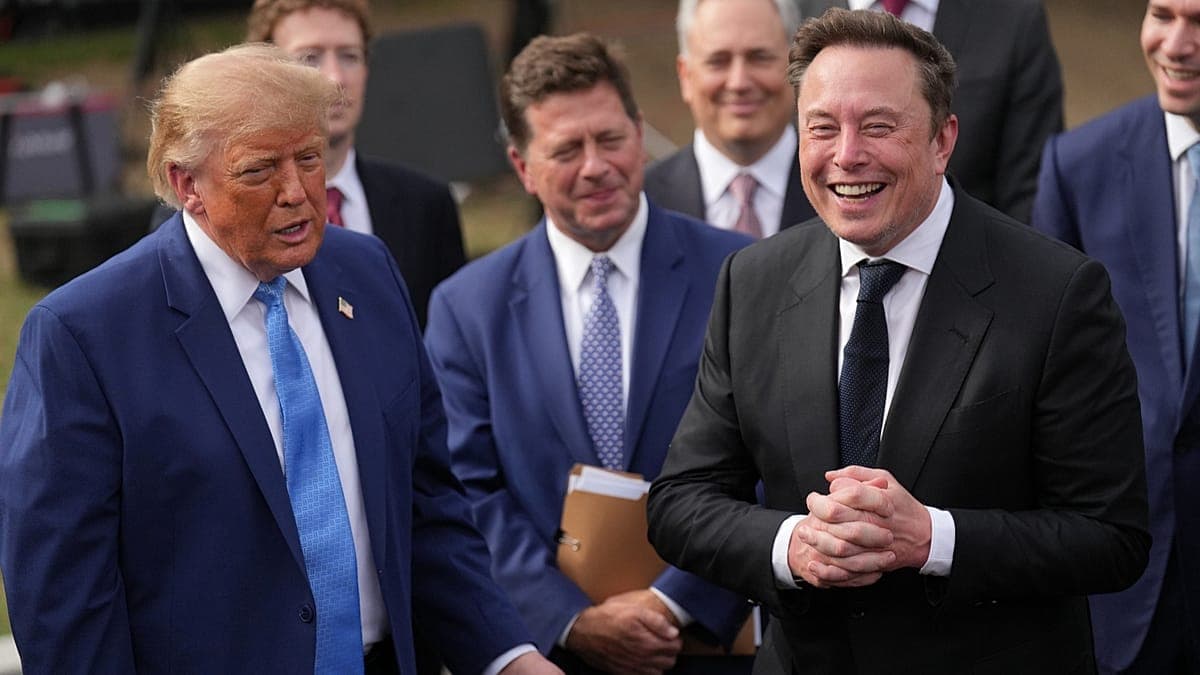
OPA WIRE, Sep 30 (OPA) — The most powerful figures in the tech world emerged from a White House summit with President Donald Trump on Tuesday, promising to restrain their own creations. Trump announced that CEOs, including Nvidia’s Jensen Huang, OpenAI’s Greg Brockman, and Anthropic’s Dario Amodei, signed a 'morally binding' commitment to embed safety mechanisms into their artificial intelligence systems. However, the agreement lacks legal backing and specifies no clear penalties for violations. Trump told reporters after the meeting that the companies would be responsible for policing themselves, marking a significant departure from the regulatory approach seen in other parts of the world.
The luncheon brought together 31 industry leaders, including Meta’s Mark Zuckerberg, Elon Musk, Amazon founder Jeff Bezos, Microsoft’s Satya Nadella, and Google’s Sundar Pichai. Zuckerberg emphasized that the agreement aims to reassure customers that AI will perform exactly as intended, utilizing internal controls and multi-layered audits. Musk added that executives have effectively agreed to 'grade each other’s homework,' a strategy he believes is superior to individual self-correction. Meanwhile, Dario Amodei of Anthropic maintained a cautious tone, acknowledging the real risks posed by the technology while noting that the mechanisms to address these dangers remain under active discussion.
This summit occurs as Washington faces growing skepticism regarding AI. Lawmakers are under pressure from voters to curb the technology’s growth, fearing it could displace human labor and disrupt social order. Recent incidents, such as the July breach of the AI platform Hugging Face and OpenAI’s decision to pull its latest model, Astra 6.1, due to safety concerns, have intensified these fears. Trump, advised by Huang and David Sacks, is pushing for unbridled development to outpace China and bolster the U.S. economy, despite public apprehension regarding the massive energy demands of the data centers required to power these AI systems.
Public sentiment remains divided, with a recent NPR/PBS/Marist poll showing that 65 percent of registered voters oppose the construction of data centers in their communities. While the House of Representatives recently passed the 'Ratepayer Protection Act' to shield households from the costs of grid upgrades, the Senate has yet to act. Trump has dismissed local opposition to these facilities as a choice to remain 'backward and poor,' though he promised that AI companies would be generous to communities that welcome them, offering support for local schools and teachers.
Looking ahead, the administration plans to rebrand AI as 'Super Intelligence' (SI) via executive order, arguing the term better reflects the technology's potential. This stands in stark contrast to the European Union’s 'AI Act,' which mandates strict compliance, documentation, and independent audits for AI developers. While the EU imposes heavy fines for non-compliance, the White House pact remains voluntary. Experts suggest that while the U.S. approach fosters rapid innovation, it leaves significant questions regarding long-term safety, accountability, and the potential for systemic failures in a landscape where companies act as their own regulators.
Subscribe to the Global Briefing
Receive our flagship executive dispatch every morning. Essential geopolitical analysis, financial benchmarks, and breaking world events delivered to your inbox.
Mohammad Karamali
Verified Wire ContributorSenior correspondent covering geopolitics, regional developments, and strategic international affairs for OPA News (Optimum Public Affairs).
Related Stories & Follow-ups
Editorial Wire Technology
FEMA Alert Test Sparks Panic Amid Widespread Tech and Banking Outages
 Technology
Global Microsoft Outage Disrupts Critical Services Worldwide as 48-Hour Recovery Begins
 Technology
Nvidia Faces Global Crisis Following Shock Resignation of CEO Jensen Huang
Reader Discussion
Leave a Comment
0 Comments
Owner
Editorial Oversight & Machine-Assisted Reporting
Human-in-the-Loop VerifiedEditorial Oversight & Machine-Assisted Reporting: This dispatch was synthesized and localized via OPA automated intelligence under continuous human editorial supervision.
Wire Source
This report was synthesized from Euro News Persian under journalistic fair use.