
The dawn of the age of the exoskeleton
Key Takeaways
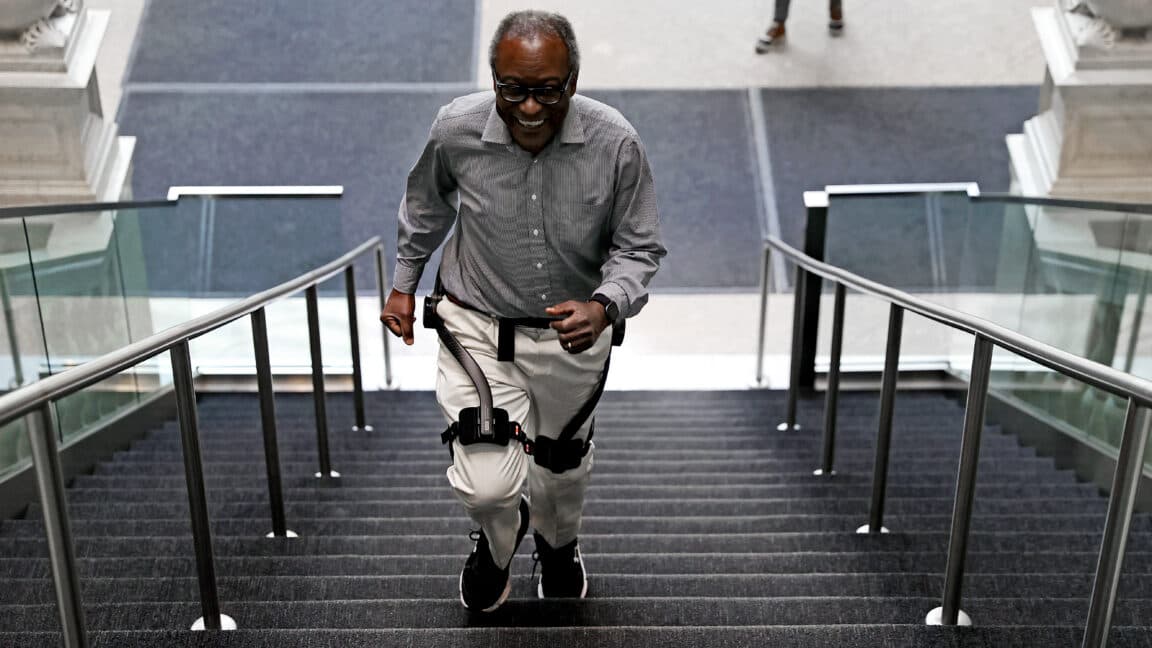
- Modern exoskeletons use sensor-driven actuators to provide real-time, proportional physical assistance based on user fatigue.
- The technology has evolved from 19th-century mechanical concepts to sophisticated, battery-powered systems used in industry and medicine.
- Current applications range from industrial ergonomic support, such as the SuitX, to mobility assistance in challenging environments like Ukraine.
OPA WIRE, Oct 3 (OPA) — The evolution of wearable robotics has transitioned from conceptual curiosities to sophisticated, life-altering technology. While the foundational ideas date back to the 19th century, modern exoskeletons now represent a convergence of advanced materials, high-torque actuators, and real-time sensor fusion. These devices are no longer restricted to laboratory settings; they are actively deployed in industrial environments, medical rehabilitation centers, and even conflict zones, fundamentally altering the human capacity for physical labor and mobility.
Technological metrics reveal a rapid maturation of the field. Modern systems like the Hypershell, currently utilized in Ukraine, demonstrate the ability to augment hip flexion and extension, while IKEA’s adoption of SuitX technology highlights the shift toward ergonomic support for torso and upper limbs. These devices rely on complex control units that process sensor data to calculate force output, ensuring that the assistance provided is proportional to the user's fatigue levels and movement trajectories, effectively bridging the gap between biological intent and mechanical execution.
Historically, the journey began in 1890 with Nicholas Yagn’s patented exercise apparatus, followed by Leslie C. Kelley’s 1919 steam-powered walking support. The 1960s marked a pivotal shift as researchers began integrating electronic control systems into actuated robotic frameworks. This progression from passive mechanical frames to intelligent, battery-powered systems has been driven by the dual needs of industrial efficiency and clinical necessity, creating a robust market for human-augmentation technologies that continue to evolve at an exponential rate.
The ramifications of this technology are profound, impacting sectors ranging from logistics to healthcare. By reducing physical strain on workers, exoskeletons mitigate the risk of musculoskeletal injuries, thereby increasing productivity and extending the professional longevity of personnel. In medical contexts, these devices provide patients with reduced physical capacity the opportunity to regain mobility, fundamentally changing the standard of care for rehabilitation. However, the integration of these systems also raises questions regarding human-machine dependency and the long-term physiological effects of relying on external mechanical support.
Looking ahead, the outlook for the exoskeleton industry is one of aggressive expansion and miniaturization. Experts anticipate that as battery density improves and control algorithms become more intuitive, these devices will become as commonplace as personal protective equipment. The future consequences will likely involve a paradigm shift in how we define human physical limits, potentially leading to a society where physical labor is augmented by default, thereby necessitating new regulatory frameworks to govern the safety and ethical implications of widespread human-robotic integration.
Subscribe to the Global Briefing
Receive our flagship executive dispatch every morning. Essential geopolitical analysis, financial benchmarks, and breaking world events delivered to your inbox.
Mohammad Karamali
Verified Wire ContributorSenior correspondent covering geopolitics, regional developments, and strategic international affairs for OPA News (Optimum Public Affairs).
Related Stories & Follow-ups
Editorial Wire Technology
FEMA Alert Test Sparks Panic Amid Widespread Tech and Banking Outages
 Technology
Global Microsoft Outage Disrupts Critical Services Worldwide as 48-Hour Recovery Begins
 Technology
Nvidia Faces Global Crisis Following Shock Resignation of CEO Jensen Huang
Reader Discussion
Leave a Comment
0 Comments
Owner
Editorial Oversight & Machine-Assisted Reporting
Human-in-the-Loop VerifiedEditorial Oversight & Machine-Assisted Reporting: This dispatch was synthesized and localized via OPA automated intelligence under continuous human editorial supervision.
Wire Source
This report was synthesized from Ars Technica under journalistic fair use.