
Australian Researchers Control Robotic Dog Using Lab-Grown Human Neurons
Key Takeaways
- Cortical Labs used lab-grown human neurons on a chip to control a robotic dog.
- The system uses electrical feedback loops to translate neural activity into physical navigation.
- The study was presented at NeurIPS 2026 and is currently available as a preprint on arXiv.
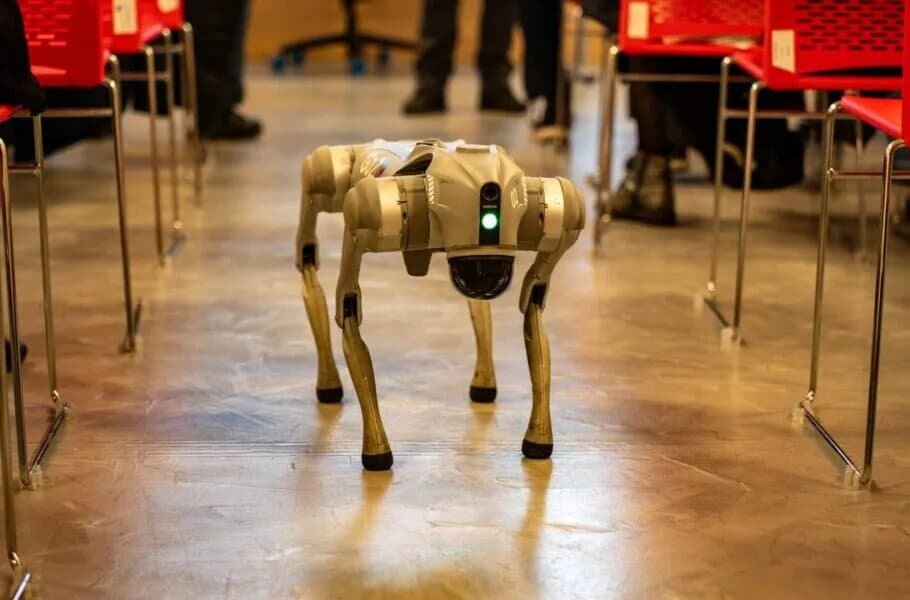
TEHRAN, Nov 1 (OPA) — Researchers at the Australian firm Cortical Labs have demonstrated a novel interface between biological tissue and robotics. By cultivating human neurons directly onto a silicon chip, the team established a feedback loop where electrical impulses from the cells dictate the movement of a robotic dog across a mapped environment. The system functions by sending signals to the neurons and interpreting their electrical responses, effectively training the biological component to guide the machine.
This experiment represents a shift from simulated environments to physical hardware. Previously, the company utilized similar biological computing arrays to play classic video games like Pong and Doom. The current iteration requires the neurons to process spatial feedback, adjusting their output to navigate the robot toward a designated target. The technical findings were presented at the NeurIPS 2026 conference, though the study remains in preprint status on arXiv and has not yet undergone formal peer review.
The primary objective of this research is to explore the viability of living cells as a computational substrate. Proponents of the technology argue that biological processors may eventually offer superior energy efficiency and adaptability in unfamiliar environments compared to traditional silicon-based systems. By leveraging the inherent plasticity of neural networks, the researchers aim to create machines capable of autonomous decision-making in complex, real-world scenarios.
Despite the successful demonstration, the technology remains in its early developmental stages. Current iterations face significant limitations regarding processing speed and operational efficiency. The research team intends to scale up the bio-chips to handle more sophisticated tasks, potentially enabling the deployment of such systems in remote or hazardous environments where traditional programming may be insufficient.
Subscribe to the Global Briefing
Receive our flagship executive dispatch every morning. Essential geopolitical analysis, financial benchmarks, and breaking world events delivered to your inbox.
Mohammad Karamali
Verified Wire ContributorSenior correspondent covering geopolitics, regional developments, and strategic international affairs for OPA News (Optimum Public Affairs).
Related Stories & Follow-ups
Editorial Wire


Reader Discussion
Leave a Comment
0 Comments
Owner
Editorial Oversight & Machine-Assisted Reporting
Human-in-the-Loop VerifiedEditorial Oversight & Machine-Assisted Reporting: This dispatch was synthesized and localized via OPA automated intelligence under continuous human editorial supervision.
Wire Source
This report was synthesized from Khabar Online under journalistic fair use.