
The Story Behind the Taliban's Most Infamous Execution: A Mother's Tragic End
Key Takeaways
- Zarmina, a mother of seven, was executed in 1999 in Kabul's Olympic Stadium after being accused of killing her abusive husband.
- The execution was captured on secret footage by RAWA activists, exposing the Taliban's brutal treatment of women to the international community.
- Human rights organizations report that the current Taliban regime is increasingly using clandestine, private punishments to avoid public and international scrutiny.
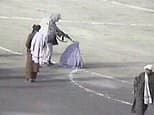
OPA WIRE, Aug 30 (OPA) — In 1999, the Kabul Olympic Stadium became the site of a harrowing public execution that shocked the global community. Zarmina, a 35-year-old mother of seven, was led onto the football pitch, forced to her knees, and executed by a single gunshot to the head in front of 30,000 spectators. The event, captured on secret video by activists from the Revolutionary Association of the Women of Afghanistan (RAWA), remains one of the most brutal symbols of the Taliban's initial reign of terror, highlighting the extreme violence inflicted upon women who resisted domestic abuse.
Zarmina had been accused of murdering her husband, a police officer named Alauddin Khwazak, who had subjected her and her daughters to months of brutal beatings. Following her arrest, she endured years of torture in prison before being sentenced to death. Despite her pleas and the presence of her own children in the stadium, the Taliban proceeded with the execution, which was carried out by her brother-in-law. Witnesses noted that the executioner was visibly unnerved, and the event left the female guards involved in the transport traumatized, with many suffering nervous breakdowns or severe psychological distress.
The context of this tragedy lies in the rise of the Taliban in the mid-1990s, following the chaos of the Soviet withdrawal and subsequent civil war. The regime imposed an ultraconservative interpretation of Sharia law, stripping women of their rights, banning education, and enforcing draconian punishments for minor infractions. Zarmina's case was particularly emblematic of the era; after her death, her surviving children were handed over to her husband's family, and her daughters were reportedly sold into sex slavery, illustrating the total lack of protection for women under the fundamentalist rule.
Nearly three decades later, the return of the Taliban to power in 2021 has sparked fears of a return to these dark days. Human rights organizations, including Rawadari, have documented a disturbing pattern of increasing restrictions on women's rights and freedoms. While the current regime often attempts to hide these punishments from public view to avoid international scrutiny, activists warn that the severity of the violence remains unchanged. The lack of transparency and the increased surveillance capabilities of the current Taliban government make it significantly harder to document the ongoing human rights violations occurring today.
Looking ahead, experts fear that the cycle of violence against women in Afghanistan is entering a new, more clandestine phase. With the international community's attention diverted and the Taliban's internal control solidified, the risk of systemic abuse is higher than ever. The legacy of Zarmina serves as a grim reminder of the cost of fundamentalist rule. As the world watches, the struggle for Afghan women's rights remains a critical humanitarian issue, with activists calling for greater global pressure to prevent the repetition of such atrocities in the shadows of the current regime.
Subscribe to the Global Briefing
Receive our flagship executive dispatch every morning. Essential geopolitical analysis, financial benchmarks, and breaking world events delivered to your inbox.
Mohammad Karamali
Verified Wire ContributorSenior correspondent covering geopolitics, regional developments, and strategic international affairs for OPA News (Optimum Public Affairs).
Related Stories & Follow-ups
Editorial Wire


Reader Discussion
Leave a Comment
0 Comments
Owner
Editorial Oversight & Machine-Assisted Reporting
Human-in-the-Loop VerifiedEditorial Oversight & Machine-Assisted Reporting: This dispatch was synthesized and localized via OPA automated intelligence under continuous human editorial supervision.
Wire Source
This report was synthesized from Daily Mail under journalistic fair use.