
From Saddam's execution to the rise and fall of ISIS: Stunning images illustrate America's two decades in Iraq as final US troops leave today
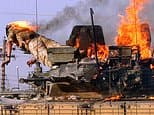
Key Takeaways
- The US-led invasion of Iraq began on March 20, 2003, involving 45,000 British troops and hundreds of thousands of US personnel.
- Official coalition deaths reached nearly 5,000, while civilian and combatant casualties are estimated to be in the hundreds of thousands.
- The final withdrawal of US troops in 2026 raises significant concerns regarding increased Iranian influence and the potential resurgence of extremist groups like ISIS.
OPA WIRE, Oct 1 (OPA) — At precisely 5:34 am on March 20, 2003, US-led coalition forces launched a surprise military invasion of Iraq, marking the beginning of a transformative and bloody two-decade chapter in Middle Eastern history. The initial assault involved hundreds of thousands of soldiers, including 45,000 British troops, who flooded into the nation to topple the regime of dictator Saddam Hussein. This monumental military operation, which began without fanfare or formal warning, fundamentally altered the geopolitical landscape of the region, setting the stage for years of occupation, insurgency, and internal strife that would define the early 21st century for both the Iraqi people and the international community.
The human cost of the conflict remains a subject of intense debate and somber reflection. While official records confirm the deaths of nearly 5,000 coalition members—including 179 British personnel—the total toll on Iraqi civilians and combatants is estimated to be in the hundreds of thousands. Former US President George W. Bush, supported by British Prime Minister Tony Blair, justified the invasion by claiming the presence of weapons of mass destruction and alleged links to al-Qaeda. These claims were later proven false, yet they served as the primary catalyst for the deposition of the autocrat and the subsequent installation of a Shi'ite-led government, which struggled to maintain stability amidst sectarian violence.
Following the capture and execution of Saddam Hussein in 2006, the US military remained deeply entrenched in the country, fighting a grueling counterinsurgency campaign. The initial withdrawal in 2011 was short-lived, as American forces returned less than three years later to assist Iraqi troops in the existential war against the Islamic State (ISIS) from 2014 to 2017. This period was characterized by intense urban warfare, the destruction of historical cities like Mosul and Fallujah, and the emergence of various paramilitary groups, including the Hashd al-Shaabi, which have since become significant power brokers in the Iraqi political arena.
As the final American troops depart their remaining bases today, the ramifications of this withdrawal are being felt across the region. Many security experts warn that the power vacuum left by the US exit could be a boon for neighboring Iran, which has cultivated deep influence within Iraq's political and military structures. The withdrawal, agreed upon in 2024 under the Biden administration and executed during a period of heightened regional tensions, has sparked fears that Tehran’s allies will gain total control, potentially allowing remnants of extremist groups like ISIS to stage a dangerous comeback.
Looking ahead, the legacy of the Iraq War remains complex and deeply contested. While some view the removal of Saddam Hussein as a necessary liberation, others see the subsequent decades as a period of missed opportunities and profound instability. As the last US convoys exit, the future of Iraq hangs in the balance, dependent on its ability to navigate internal sectarian divisions and external pressures from regional powers. The stunning visual record of these two decades—from the toppling of statues in Firdos Square to the ruins of Mosul—serves as a stark reminder of the enduring consequences of military intervention.
Subscribe to the Global Briefing
Receive our flagship executive dispatch every morning. Essential geopolitical analysis, financial benchmarks, and breaking world events delivered to your inbox.
Mohammad Karamali
Verified Wire ContributorSenior correspondent covering geopolitics, regional developments, and strategic international affairs for OPA News (Optimum Public Affairs).
Related Stories & Follow-ups
Editorial Wire


Reader Discussion
Leave a Comment
0 Comments
Owner
Editorial Oversight & Machine-Assisted Reporting
Human-in-the-Loop VerifiedEditorial Oversight & Machine-Assisted Reporting: This dispatch was synthesized and localized via OPA automated intelligence under continuous human editorial supervision.
Wire Source
This report was synthesized from Daily Mail under journalistic fair use.