
US Balances Rhetoric of Peace with Escalation Preparations in Iran Conflict
Key Takeaways
- The US is deploying additional carrier strike groups to the Middle East while simultaneously signaling a potential end to the conflict.
- Western intelligence reports an average of 40 weekly attacks on commercial shipping in the Strait of Hormuz since August.
- The G7 will release 100 million barrels of oil to combat rising fuel costs that are impacting US midterm election dynamics.
OPA WIRE, Oct 3 (OPA) — While President Donald Trump publicly suggests that the conflict with Iran could conclude shortly after the upcoming elections, reports indicate that his administration is simultaneously intensifying military preparations. A high-level, unannounced security meeting at Camp David, chaired by Vice President JD Vance, brought together top officials including Secretary of State Marco Rubio and Defense Secretary Pete Hegseth to deliberate on the next phases of the military campaign. This dual-track approach has created a notable disconnect between the administration's optimistic public messaging and its strategic military posture.
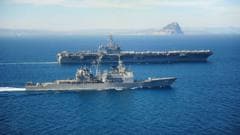
During the Camp David session, officials reportedly made critical decisions regarding the Middle East, though the White House has remained silent on the specifics. Military data confirms the deployment of the USS Theodore Roosevelt carrier strike group and the Makin Island amphibious ready group to the region. These additions could bring the total US presence to three carrier strike groups and two amphibious ready groups. Despite these maneuvers, Trump continues to claim that Iran is on the verge of surrender, predicting a resolution before or immediately following the November congressional elections.
Historically, such high-level meetings at Camp David have preceded significant escalations, with observers noting a similar session occurred just days before the twelve-day war in June 2025. The current diplomatic landscape remains gridlocked, as both Washington and Tehran express a preference for a negotiated settlement but remain divided by fundamental differences in approach. While Trump seeks a rapid, decisive agreement, Tehran favors a phased, long-term process, further complicated by deep-seated mutual distrust and intense domestic political pressures within both nations.
Beyond the diplomatic impasse, the security situation in the Strait of Hormuz remains volatile. Western security data suggests that Iran has conducted approximately 30 drone attacks and 10 anti-ship missile strikes weekly since August. Although the flow of crude oil has seen a partial recovery due to US military protection, the transit of refined products like gasoline and diesel remains significantly below pre-war levels. The ongoing instability, marked by recent attacks on commercial vessels, indicates that the threat to maritime navigation is persistent rather than sporadic.
Looking ahead, the conflict's economic ramifications are increasingly influencing US domestic politics. With diesel prices exceeding six dollars per gallon, the G7 has agreed to release 100 million barrels from emergency reserves to stabilize the market. Analysts warn that this is merely a short-term fix for a structural energy crisis. As the midterm elections approach, the intersection of rising inflation, fuel costs, and military spending is forcing the administration to navigate a complex political landscape where the war's outcome is inextricably linked to the economic well-being of the American electorate.
Subscribe to the Global Briefing
Receive our flagship executive dispatch every morning. Essential geopolitical analysis, financial benchmarks, and breaking world events delivered to your inbox.
Mohammad Karamali
Verified Wire ContributorSenior correspondent covering geopolitics, regional developments, and strategic international affairs for OPA News (Optimum Public Affairs).
Related Stories & Follow-ups
Editorial Wire


Reader Discussion
Leave a Comment
0 Comments
Owner
Editorial Oversight & Machine-Assisted Reporting
Human-in-the-Loop VerifiedEditorial Oversight & Machine-Assisted Reporting: This dispatch was synthesized and localized via OPA automated intelligence under continuous human editorial supervision.
Wire Source
This report was synthesized from BBC Persian under journalistic fair use.