
Diwali Celebrations Complicate Hazardous Winter Air Quality Across South Asia
Key Takeaways
- Diwali celebrations begin Sunday, with traditional fireworks worsening existing winter smog across South Asia.
- Delhi's fine particle pollution averaged roughly 19 times WHO annual guidelines last year.
- Experts recommend properly fitted N95 or N99 masks and HEPA air purifiers to mitigate exposure.
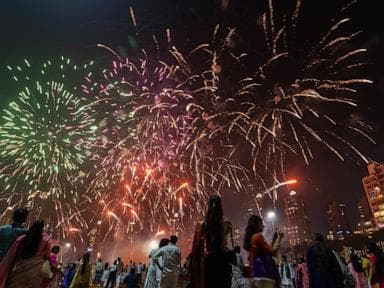
OPA WIRE, Nov 7 (OPA) — Diwali celebrations across South Asia coincide with the return of hazardous winter air, raising concerns about safe festivities as fireworks add a sharp burst of pollution to an already critical problem. Across India, Pakistan and neighboring regions, traffic, construction dust, factory emissions and crop residue burning combine with weak winter winds to trap pollutants near the ground. Experts emphasize that simple measures such as checking the air quality index, wearing well-fitting masks and deploying air purifiers can reduce exposure, though personal precautions have strict limits.
India’s air quality index converts pollution measurements into health warnings, designating readings of 201–300 as poor, 301–400 as very poor and 401–500 as severe. In Delhi, fine particle pollution averaged about 19 times the World Health Organization’s annual guideline last year, with monitors repeatedly hitting maximum display readings. Dr. Arvind Kumar, a chest surgeon at Medanta hospital and founder trustee of the Lung Care Foundation, recommends properly fitted N95 or N99 masks outdoors during heavy pollution to filter at least 95% or 99% of airborne particles, respectively.
Public health experts note that poor air quality is a year-round crisis in the region, driven by structural sources that seasonal restrictions fail to resolve. While temporary municipal curbs on construction and vehicles attempt to mitigate spikes, city authorities in Delhi are also implementing long-term plans to promote electric vehicles. Indoor air management remains vital, with recommendations to use high-efficiency particulate air (HEPA) purifiers, avoid burning incense or candles, and replace dry sweeping with damp-mopping to prevent stirring up settled dust particles.
Despite individual mitigation strategies, public health advocates stress that personal gear cannot substitute for systemic policy changes. Shweta Narayan of the Global Climate and Health Alliance pointed out that outdoor workers cannot simply stay home and many families cannot afford air purifiers. Lasting protection requires governments to target pollution sources directly while ensuring affordable health care for vulnerable populations, holding authorities accountable for long-term air cleanup.
Subscribe to the Global Briefing
Receive our flagship executive dispatch every morning. Essential geopolitical analysis, financial benchmarks, and breaking world events delivered to your inbox.
Mohammad Karamali
Verified Wire ContributorSenior correspondent covering geopolitics, regional developments, and strategic international affairs for OPA News (Optimum Public Affairs).
Related Stories & Follow-ups
Editorial Wire
Reader Discussion
Leave a Comment
0 Comments
Owner
Editorial Oversight & Machine-Assisted Reporting
Human-in-the-Loop VerifiedEditorial Oversight & Machine-Assisted Reporting: This dispatch was synthesized and localized via OPA automated intelligence under continuous human editorial supervision.
Wire Source
This report was synthesized from ABC under journalistic fair use.