
Iran's Election to UN Counterterrorism Committee Sparks Western Outrage
Key Takeaways
- Iran was elected to the UN Committee for Programme and Coordination in a secret ballot on Wednesday.
- Australia and Canada voted against the appointment, citing Iran's human rights violations.
- UK officials defended the nomination as an automatic regional procedure rather than an endorsement.
OPA WIRE, Nov 12 (OPA) — The United Nations General Assembly voted on Wednesday to place Iran on the Committee for Programme and Coordination, a 34-member body tasked with reviewing UN programs and assessing their implementation. While Western nations including the United States, Canada, and Australia voted against the inclusion, the outcome triggered immediate political fallout in London over the United Kingdom's handling of the nomination process.
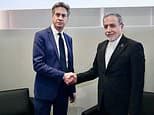
Senior Conservative MP and shadow foreign minister Alicia Kearns criticized the UK government on X, questioning why Foreign Secretary Ed Miliband recently shook hands with Iranian Foreign Affairs Minister Abbas Araghchi on the sidelines of the UN General Assembly in September. "The UK nominated Iran to join this committee. Why @Ed_Miliband? Is this what you shook hands over?" Kearns wrote. Australian Foreign Minister Penny Wong also condemned the result, stating that Tehran's conduct undermines multilateralism and that Australia stands with the Iranian people. Canadian Foreign Minister Anita Anand echoed the sentiment, asserting that the committee must be comprised of states entrusted with upholding the principles of the UN Charter.
In response to mounting domestic criticism, British officials defended the government's stance, arguing that Iran's progression to the ballot was a procedural inevitability. Foreign Office minister Hamish Falconer told parliament in April that the nomination through the Asia-Pacific Group operated on an automatic basis without a direct option for London to block the appointment. Parliamentary answers further clarified that regional groups put forward candidates like Iran, India, Japan, and Pakistan without requiring a formal expression of bilateral support from individual member states.
The Foreign Office previously defended maintaining diplomatic channels with Tehran, maintaining that dialogue remains necessary to address Middle East conflicts and warn against hostile activities on British soil. The Committee for Programme and Coordination operates on three-year terms and exerts direct influence over how the UN structures its human rights and security mandates. Further diplomatic fallout is anticipated as Western capitals assess the operational impact of Tehran's new committee seat.
Subscribe to the Global Briefing
Receive our flagship executive dispatch every morning. Essential geopolitical analysis, financial benchmarks, and breaking world events delivered to your inbox.
Mohammad Karamali
Verified Wire ContributorSenior correspondent covering geopolitics, regional developments, and strategic international affairs for OPA News (Optimum Public Affairs).
Related Stories & Follow-ups
Editorial Wire

Reader Discussion
Leave a Comment
0 Comments
Owner
Editorial Oversight & Machine-Assisted Reporting
Human-in-the-Loop VerifiedEditorial Oversight & Machine-Assisted Reporting: This dispatch was synthesized and localized via OPA automated intelligence under continuous human editorial supervision.
Wire Source
This report was synthesized from Daily Mail under journalistic fair use.