
Iran's Revolutionary Guard Unveils Underground Missile Facility Amid Rebuilding Efforts
Key Takeaways
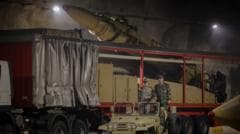
- The IRGC released footage of an underground missile base on Tuesday, featuring ballistic and cruise missiles.
- High-ranking officials including Gen. Ali Abdollahi and Gen. Majid Mousavi inspected the subterranean facility.
- Military analysts identified an obscured weapon in the footage as a possible advanced variant of the Paveh cruise missile.
OPA WIRE, Nov 14 (OPA) — The footage, broadcast on Tuesday, November 11, shows high-ranking military officials—including General Ali Abdollahi, chief of staff of the armed forces and commander of the Khatam al-Anbiya Central Headquarters, alongside Brigadier General Majid Mousavi, commander of the IRGC Aerospace Force—inspecting the subterranean complex. The facility houses an array of ballistic and cruise missiles, alongside mobile launchers. However, independent verification of the base's exact geographic location, construction timeline, operational capacity, or whether it represents a newly constructed installation remains unconfirmed.
Defense analysts and open-source intelligence suggest the release is strategically timed following a 40-day conflict that targeted key Iranian military infrastructure, including production sites and propellant facilities. Satellite imagery previously analyzed by verification desks indicated active reconstruction at sites such as the Garmdareh base in Karaj and the Imam Ali base in Kermanshah. Security experts note that recycling footage of older, previously unseen tunnels is a frequent tactic used by military authorities to project strength and deter further aerial strikes.
Among the hardware displayed, the IRGC obscured a specific cruise missile model, which defense specialist Fabian Hinz identified as a likely derivative of the Paveh cruise missile family. The Paveh, possessing an estimated range of 1,650 kilometers, is designed for coordinated swarm attacks and utilizes routing capabilities demonstrated in previous regional engagements. A secondary, black-painted cruise missile was also briefly shown, though technical specifications for this munition have not been officially disclosed by military authorities.
While the IRGC has withheld technical data regarding ranges, propulsion systems, and total inventory numbers within the facility, the broadcast serves a clear deterrence function. The presence of top military leadership underscores Tehran's intent to signal that its strategic arsenal remains functional despite sustained aerial bombardment. Observers caution that displaying underground stockpiles does not automatically confirm operational readiness or validate claims that the entire showcased inventory survived recent engagements intact.
Subscribe to the Global Briefing
Receive our flagship executive dispatch every morning. Essential geopolitical analysis, financial benchmarks, and breaking world events delivered to your inbox.
Mohammad Karamali
Verified Wire ContributorSenior correspondent covering geopolitics, regional developments, and strategic international affairs for OPA News (Optimum Public Affairs).
Related Stories & Follow-ups
Editorial Wire


Reader Discussion
Leave a Comment
0 Comments
Owner
Editorial Oversight & Machine-Assisted Reporting
Human-in-the-Loop VerifiedEditorial Oversight & Machine-Assisted Reporting: This dispatch was synthesized and localized via OPA automated intelligence under continuous human editorial supervision.
Wire Source
This report was synthesized from BBC Persian under journalistic fair use.