
Houthi Red Sea Advances Expand Iran's Strategic Leverage
Key Takeaways
- Government forces withdrew from the Bab el-Mandeb region on Nov. 15.
- Saudi Red Sea oil exports dropped from 3.5 million barrels per day in June to under 400,000 in October, per Kpler.
- Iranian President Masoud Pezeshkian stated on Sept. 13 that Iran is not at war with Saudi Arabia.
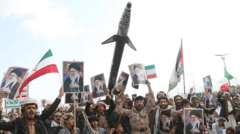
OPA WIRE, Nov 29 (OPA) — Houthi forces are advancing closer to Aden following the Nov. 15 withdrawal of government forces from the Bab el-Mandeb region, placing vital Red Sea shipping lanes under insurgent control. Tehran has long maintained official distance from Houthi military actions, consistently referring to the group simply as "Yemen" and denying direct material support or coordination in attacks targeting Saudi infrastructure.
Despite official denials, Iranian state media and hardline outlets have openly celebrated the Houthi advances and the resulting pressure exerted on Saudi Arabia. Iranian President Masoud Pezeshkian emphasized on Sept. 13 that Tehran is not at war with Saudi Arabia, maintaining that the group acts independently in response to domestic conditions amid ongoing regional tensions.
Control over the Bab el-Mandeb corridor grants the Houthis direct leverage over a crucial maritime chokepoint through which roughly 12 percent of global trade normally passes. The corridor has served as a vital alternative route for Saudi oil exports via the East-West pipeline to the Red Sea port of Yanbu, bypassing the Strait of Hormuz.
However, escalating Houthi operations have severely disrupted regional energy transit. Commodity analytics firm Kpler reported that Saudi Red Sea oil exports via Bab el-Mandeb plummeted from nearly 3.5 million barrels per day in June to under 400,000 barrels per day by October, reshaping maritime trade routes.
Subscribe to the Global Briefing
Receive our flagship executive dispatch every morning. Essential geopolitical analysis, financial benchmarks, and breaking world events delivered to your inbox.
Mohammad Karamali
Verified Wire ContributorSenior correspondent covering geopolitics, regional developments, and strategic international affairs for OPA News (Optimum Public Affairs).
Related Stories & Follow-ups
Editorial Wire


Reader Discussion
Leave a Comment
0 Comments
Owner
Editorial Oversight & Machine-Assisted Reporting
Human-in-the-Loop VerifiedEditorial Oversight & Machine-Assisted Reporting: This dispatch was synthesized and localized via OPA automated intelligence under continuous human editorial supervision.
Wire Source
This report was synthesized from BBC Persian under journalistic fair use.