
US Supreme Court Hears Challenge to Local Climate Lawsuits Against Energy Giants
Key Takeaways
- Eight Supreme Court justices heard arguments in Suncor Energy v. Commissioners of Boulder County after Justice Samuel Alito recused himself.
- Energy companies argue the Clean Air Act and federal jurisdiction preempt state-level lawsuits seeking climate damages.
- A 4-4 deadlock would uphold the Colorado Supreme Court's decision, allowing Boulder to proceed with its lawsuit against Exxon and Suncor.
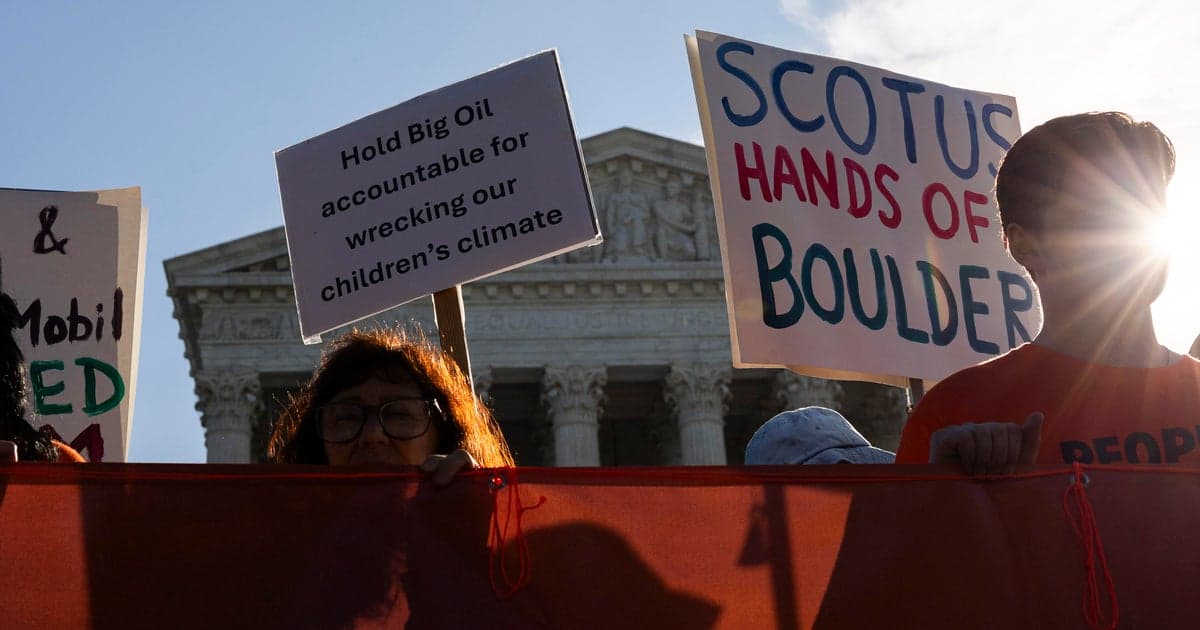
The U.S. Supreme Court on Monday heard nearly two hours of oral arguments in Suncor Energy v. Commissioners of Boulder County, weighing whether local governments can use state courts to hold energy companies financially liable for climate change damages. Eight justices presided over the proceedings following Justice Samuel Alito's recusal, which was announced without an official reason after financial disclosures indicated he held assets in other energy firms. A potential 4-4 tie would leave the Colorado Supreme Court's ruling in place, allowing Boulder's landmark 2018 lawsuit to advance.
Conservative justices raised concerns regarding national energy policy and federal authority over interstate emissions, with Justice Brett Kavanaugh stressing that multiple precedents since 1972 establish interstate air pollution as a federal matter governed by the Clean Air Act. Backing Exxon Mobil and Suncor, Principal Deputy Solicitor General Sarah Harris argued that the lawsuit "egregiously exceeds" constitutional limits. In contrast, Justice Ketanji Brown Jackson questioned whether the Supreme Court's intervention was premature, suggesting the court lacked sufficient findings on whether the proposed preemption theories properly applied at this stage.
The lawsuit filed by the city and county of Boulder is part of a nationwide wave of litigation seeking monetary damages from major oil producers for localized harms such as extreme heat and wildfire destruction. Boulder claims that deceptive marketing and fossil fuel production induced runaway greenhouse gas emissions. Exxon and Suncor's attorney, Kannon Shanmugam, cautioned that permitting state lawsuits would enable roughly 90,000 municipalities to set national climate policy and risk imposing "catastrophic damages" on energy producers through local juries.
While Chief Justice John Roberts questioned how thousands of municipal lawsuits would function practically, he noted historical exceptions where state courts adjudicate out-of-state conduct that produces substantial local impacts. If the Supreme Court upholds the Colorado ruling or splits evenly, Boulder’s claims will return to lower state courts for further litigation on the merits, establishing a critical procedural blueprint for dozens of similar pending climate disputes across the United States.
Related Stories & Follow-ups
Editorial Wire Politics
Zelenskyy Urges Sanctions Enforcement After Trump Pauses Measures Against Russia
 Politics
Reports Allege Elon Musk and Donald Trump Coordinated Starlink Restrictions in Ukraine
 Politics
Trump Waives Sanctions on Russian Oil Buyers to Ease Domestic Energy Prices
Reader Discussion
Leave a Comment
0 Comments
Owner
Editorial Oversight & Machine-Assisted Reporting
Human-in-the-Loop VerifiedEditorial Oversight & Machine-Assisted Reporting: This dispatch was synthesized and localized via OPA automated intelligence under continuous human editorial supervision.
Wire Source
This report was synthesized from CBS under journalistic fair use.