
Dinosaur-killing impact crater might have been teeming with life
Key Takeaways
- The Chicxulub hydrothermal system remained active for 8 million years, four times longer than previously estimated.
- Potassium-argon dating of feldspar samples confirmed the system stayed heated from 66 million to 58 million years ago.
- Larger impact basins on early Earth may have sustained habitable hydrothermal conditions for significantly longer durations.
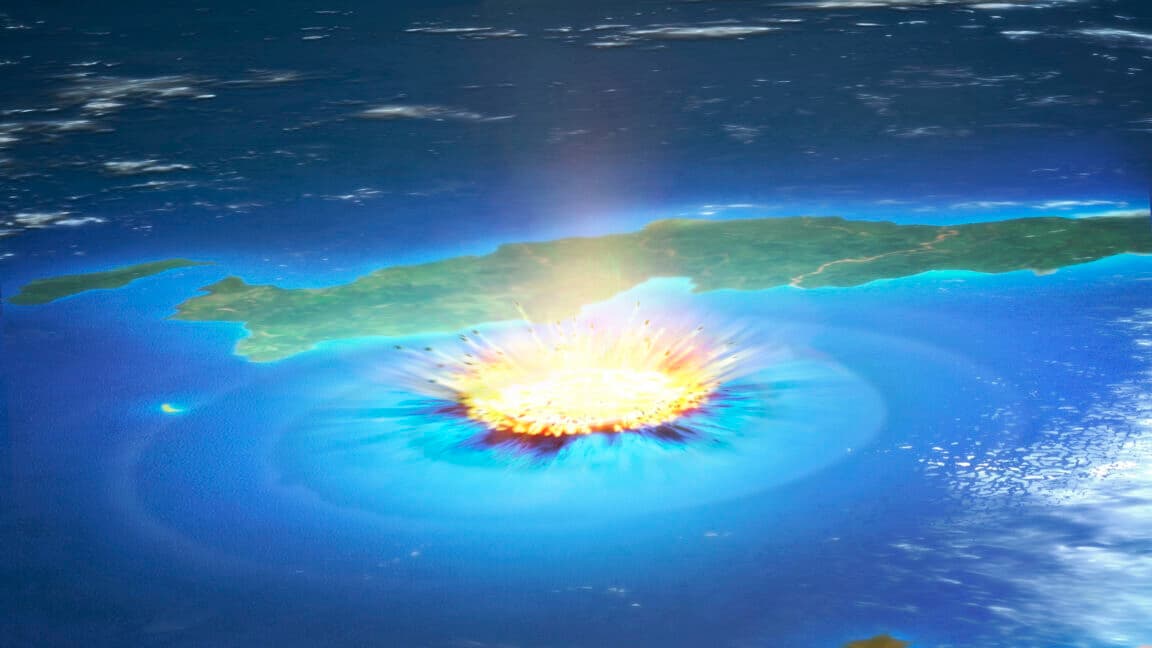
OPA WIRE, Oct 1 (OPA) — Approximately 66 million years ago, the Chicxulub asteroid struck the Yucatan Peninsula, triggering a global catastrophe that wiped out non-avian dinosaurs. While the event is synonymous with mass extinction, recent geological research suggests the impact site itself became an unexpected sanctuary. Deep beneath the ocean floor, the intense heat generated by the collision created a massive, long-lasting hydrothermal system that may have provided a fertile environment for microbial life to thrive for millions of years.
New analysis led by geologist Annemarie Pickersgill of the University of Glasgow challenges previous estimates regarding the longevity of this subterranean ecosystem. While scientists once believed the hydrothermal activity persisted for only 2 million years, isotopic measurements of feldspar samples indicate the system remained active for at least 8 million years. Pickersgill notes that these extended windows of hydrothermal activity create significant opportunities for prebiotic chemistry and the propagation of microorganisms.
The formation of this system was a direct result of the asteroid's immense energy, which deformed the Earth's crust to a depth of 35 kilometers. The melting of rock and the subsequent infiltration of seawater into porous, heated subterranean structures created a unique environment. Researchers utilized potassium-argon dating, measuring the decay of potassium-40 into argon-40, to determine that the system remained thermally active from the moment of impact until approximately 58 million years ago.
This discovery has profound ramifications for our understanding of planetary habitability. Although hydrothermal systems are common in impact craters, evidence of life colonizing them remains elusive, with microbes identified in only eight of 70 studied sites. The Chicxulub findings suggest that the duration of heat and nutrient flow is the critical variable in determining whether an impact site can support life. By providing a stable, warm habitat, the crater may have acted as a refuge during the post-impact recovery period.
Looking forward, the study provides a framework for evaluating other impact basins across the solar system. Pickersgill emphasizes that Chicxulub is relatively small compared to ancient impact basins found on early Earth and other planets. Consequently, larger impacts may have sustained hydrothermal systems for even longer periods, potentially serving as crucibles for the development of life. This research shifts the narrative from viewing asteroid impacts solely as agents of destruction to recognizing them as potential catalysts for biological evolution.
Subscribe to the Global Briefing
Receive our flagship executive dispatch every morning. Essential geopolitical analysis, financial benchmarks, and breaking world events delivered to your inbox.
Mohammad Karamali
Verified Wire ContributorSenior correspondent covering geopolitics, regional developments, and strategic international affairs for OPA News (Optimum Public Affairs).
Related Stories & Follow-ups
Editorial Wire


Reader Discussion
Leave a Comment
0 Comments
Owner
Editorial Oversight & Machine-Assisted Reporting
Human-in-the-Loop VerifiedEditorial Oversight & Machine-Assisted Reporting: This dispatch was synthesized and localized via OPA automated intelligence under continuous human editorial supervision.
Wire Source
This report was synthesized from Ars Technica under journalistic fair use.