
Swiss glaciers lose over 5% of ice volume in 2026 as heat waves, low winter snow accelerate thaw
Key Takeaways
- Swiss glaciers lost 5.5% of their total volume in 2026, the second-highest annual drop on record.
- The total volume of Swiss glacier ice is now only one-third of what it was 23 years ago.
- Switzerland lost 2.2 trillion liters of water in three months, four times the nation's annual consumption.
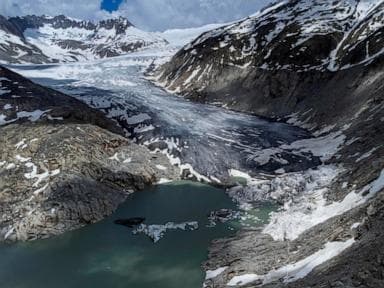
OPA WIRE, Oct 1 (OPA) — Glaciers across Switzerland, home to the most significant ice formations in the Alps, have suffered a staggering 5.5% loss in ice volume this year. Experts from the GLAMOS monitoring service and the Swiss Academy of Sciences report that this represents the second-largest percentage drop on record. Driven by persistent heat waves and critically low winter snowfall, the rapid degradation of these glaciers highlights the intensifying impact of global warming on Europe, which currently stands as the world's fastest-warming continent.
Data from the latest report indicates that over the past five years alone, Switzerland has lost nearly one-fifth of its total glacier volume. Matthias Huss, head of GLAMOS, emphasized that the current warming trend is entirely attributable to anthropogenic climate change, stating that without human-induced emissions, such warming would not be occurring. The report notes that individual glaciers have seen their average thickness decline by 2.5 to 4 meters, with some glacier tongues receding by as much as 10 meters, marking record-breaking melt rates for major formations like the Aletsch and Rhone glaciers.
Historically, the most severe retreat occurred in 2022, exacerbated by Saharan dust that darkened the ice and increased heat absorption. While the absolute volume lost in 2003 was higher, the current percentage decline is more alarming because the total remaining ice volume is now only about one-third of what it was 23 years ago. Winter snow cover, which traditionally protects ice from summer heat and facilitates the formation of new ice at high elevations, has been insufficient, leaving the glaciers increasingly vulnerable to atmospheric temperature spikes.
The ramifications of this accelerated thaw are profound, extending far beyond the Swiss borders. Switzerland acts as the 'water tower of Europe,' feeding critical rivers such as the Rhine, Rhone, Danube, and Po. The loss of 2.2 trillion liters of water between July and September alone is equivalent to four times the annual water consumption of the entire Swiss population. Furthermore, the destabilization of mountain slopes, as seen in recent Himalayan disasters, serves as a grim reminder of the global nature of this crisis, threatening infrastructure and ecosystems alike.
Looking ahead, experts warn that while it may be nearly too late to save the glaciers of the Swiss Alps, global efforts to stabilize the climate remain vital. Reducing CO2 emissions is the only path to mitigating further damage and protecting polar ice sheets, which are essential for preventing catastrophic sea-level rise. As the world faces these environmental shifts, the scientific consensus remains clear: immediate and drastic action is required to limit the long-term consequences for billions of people living in vulnerable coastal regions worldwide.
Subscribe to the Global Briefing
Receive our flagship executive dispatch every morning. Essential geopolitical analysis, financial benchmarks, and breaking world events delivered to your inbox.
Mohammad Karamali
Verified Wire ContributorSenior correspondent covering geopolitics, regional developments, and strategic international affairs for OPA News (Optimum Public Affairs).
Related Stories & Follow-ups
Editorial Wire


Reader Discussion
Leave a Comment
0 Comments
Owner
Editorial Oversight & Machine-Assisted Reporting
Human-in-the-Loop VerifiedEditorial Oversight & Machine-Assisted Reporting: This dispatch was synthesized and localized via OPA automated intelligence under continuous human editorial supervision.
Wire Source
This report was synthesized from ABC under journalistic fair use.