
Huge row over microscope photograph contest winner's 'AI fake' video
Key Takeaways
- Dr. Ning Xu won the $3,000 Nikon Small World in Motion prize for a video depicting cilia, but faces accusations of using AI to manipulate the footage.
- Critics identified potential AI markers, including a Google SynthID watermark and unnatural visual artifacts, prompting a formal investigation by Nikon.
- The contest rules explicitly ban generative AI for content creation, though they allow for specific post-processing techniques, creating a complex regulatory challenge.
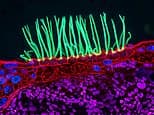
OPA WIRE, Oct 2 (OPA) — The scientific community is currently embroiled in a heated controversy following allegations that the winner of the prestigious Nikon Small World in Motion contest utilized artificial intelligence to manipulate his entry. Dr. Ning Xu, formerly a researcher at Tsinghua University, faced intense scrutiny after his winning video, which depicted cilia in the airways of a child with primary ciliary dyskinesia, was accused of being an AI-generated fabrication. The competition, which awards a $3,000 prize, is designed to showcase the beauty of the microscopic world, but the recent revelations have cast a shadow over the integrity of the 16th annual event.
Critics, including doctoral student Ian Donovan and associate professor Edward Phelps, pointed to suspicious visual anomalies, such as cilia appearing to pop in and out of existence and the presence of a Google SynthID watermark. In response to the backlash, Dr. Xu admitted to using AI tools for aesthetic purposes, specifically to colorize the grayscale data, while vehemently denying that the core experimental footage or the motion of the cilia were AI-generated. Nikon has since launched a formal investigation, stating that they are reviewing the technical documentation provided by the researcher to determine if any competition rules were violated.
The Nikon Small World in Motion contest has long served as a bridge between scientific research and artistic expression, rewarding those who capture the unseen wonders of biology. Historically, the competition has permitted certain post-processing techniques to enhance visibility, provided they do not alter the fundamental scientific data. However, the rise of generative AI has complicated these guidelines, forcing organizers to distinguish between legitimate image enhancement and the creation of synthetic elements that could mislead the scientific community or the public.
The ramifications of this scandal extend beyond the individual researcher, threatening the credibility of scientific imaging competitions at large. Fellow scientists, such as Dr. Patrick Hickey, have expressed concern that if the winning video was indeed unfairly altered, it would undermine the hard work of other entrants who adhered strictly to the rules. The incident has sparked a broader debate regarding the ethics of AI in scientific communication, highlighting the tension between the need for visual clarity and the imperative to maintain scientific honesty in an era of increasingly sophisticated digital manipulation.
Looking ahead, the controversy is likely to force Nikon and other scientific organizations to tighten their submission policies regarding AI usage. Experts suggest that the future of such competitions will require more rigorous verification processes, potentially including mandatory disclosure of all software tools used in post-processing. As the line between scientific data and artistic visualization continues to blur, the scientific community must establish clear ethical boundaries to ensure that the pursuit of beauty does not come at the expense of empirical truth and institutional trust.
Subscribe to the Global Briefing
Receive our flagship executive dispatch every morning. Essential geopolitical analysis, financial benchmarks, and breaking world events delivered to your inbox.
Mohammad Karamali
Verified Wire ContributorSenior correspondent covering geopolitics, regional developments, and strategic international affairs for OPA News (Optimum Public Affairs).
Related Stories & Follow-ups
Editorial Wire


Reader Discussion
Leave a Comment
0 Comments
Owner
Editorial Oversight & Machine-Assisted Reporting
Human-in-the-Loop VerifiedEditorial Oversight & Machine-Assisted Reporting: This dispatch was synthesized and localized via OPA automated intelligence under continuous human editorial supervision.
Wire Source
This report was synthesized from Daily Mail under journalistic fair use.