
How climate change worsened Nepal's deadly mountain collapse
Key Takeaways
- The collapse involved 110 million cubic meters of debris, equivalent to 44,000 Olympic swimming pools.
- Glacier retreat accelerated significantly, with 373 meters lost between 2010 and 2026 compared to 75 meters from 1964-2000.
- Early warning systems failed because the flood reached the border in 7 minutes, while alerts were sent after 38 minutes.
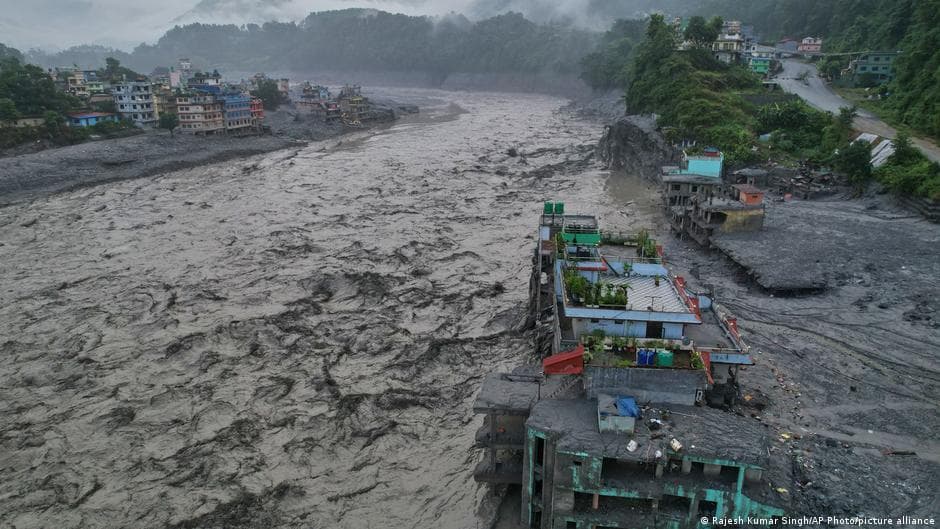
OPA WIRE, Oct 2 (OPA) — Nearly 1,400 people have died and over 5,000 remain missing following a catastrophic mountain slope collapse and subsequent flash floods in Nepal and Tibet. Initially attributed to seismic activity, glaciologists and climate scientists have now confirmed that the disaster was the result of a complex interplay of environmental factors, with climate change acting as the primary catalyst. The collapse occurred on August 26, triggered by receding glaciers, thawing permafrost, and extreme meltwater accumulation that destabilized the mountain face.
Walter Immerzeel, a mountain hydrologist at Utrecht University, emphasized that the failure was not a single event but a culmination of processes spanning years. The collapse involved 110 million cubic meters of rock and ice—equivalent to 44,000 Olympic swimming pools—falling from an elevation of 5,150 meters. The impact generated energy comparable to a magnitude 5.2 earthquake, tearing up additional buried glacier ice and creating a debris-heavy torrent that reached speeds of 170 kilometers per hour, devastating everything in its path within minutes.
Historical data reveals that the glacier near the failure site retreated 373 meters between 2010 and 2026, a significant acceleration compared to the previous four decades. This retreat stripped away the structural support for the rock wall, while thawing permafrost at critical elevations further compromised stability. The region experienced record-breaking temperatures in July and August, with climate change contributing an additional 1.5 degrees Celsius to the area, further exacerbated by an unusually snowy October in 2025 that increased meltwater volumes.
The ramifications of this disaster are profound, as the scale of the destruction overwhelmed existing early warning systems. Nepal’s infrastructure is designed for rainfall-driven floods rather than cascading mountain failures. Consequently, the flood outpaced emergency alerts, with the first SMS warnings arriving 38 minutes after the collapse, long after the torrent had crossed the border. Families in affected areas like Devighat are now left to salvage remnants of their lives from mud-filled ruins, facing a long and uncertain recovery process.
Expert analysis from World Weather Attribution suggests that this event represents a threshold where local adaptation strategies are no longer sufficient. Friederike Otto of Imperial College London warned that as global warming continues to destabilize high-altitude regions, such disasters will become increasingly frequent. The scientific consensus is clear: without a rapid global transition away from fossil fuels, the structural integrity of the world's mountain ranges will continue to degrade, leading to further large-scale humanitarian catastrophes.
Subscribe to the Global Briefing
Receive our flagship executive dispatch every morning. Essential geopolitical analysis, financial benchmarks, and breaking world events delivered to your inbox.
Mohammad Karamali
Verified Wire ContributorSenior correspondent covering geopolitics, regional developments, and strategic international affairs for OPA News (Optimum Public Affairs).
Related Stories & Follow-ups
Editorial Wire


Reader Discussion
Leave a Comment
0 Comments
Owner
Editorial Oversight & Machine-Assisted Reporting
Human-in-the-Loop VerifiedEditorial Oversight & Machine-Assisted Reporting: This dispatch was synthesized and localized via OPA automated intelligence under continuous human editorial supervision.
Wire Source
This report was synthesized from DW English under journalistic fair use.