
Discovery of Ancient City Penico Reveals Climate Adaptation Without Warfare in Peru
Key Takeaways
- Archaeologist Dr. Ruth Shady revealed the 3,800-year-old city of Penico in Peru's Supe Valley.
- The Caral civilization adapted to a severe 130-year drought through upstream relocation rather than warfare.
- Excavations at Penico uncovered 18 structures devoid of defensive walls, weapons, or signs of conflict.
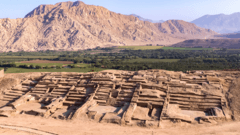
OPA WIRE, Oct 6 (OPA) — Archaeologists in Peru have unveiled the discovery of Penico, a 3,800-year-old settlement belonging to the ancient Caral civilization, which reshapes understanding of how early American societies coped with environmental disaster. Located in the Supe Valley approximately four hours north of Lima, the newly excavated site contains 18 structures, including ceremonial temples and residential quarters. The findings indicate that rather than collapsing into conflict when severe climate shifts struck the region, the population adapted peacefully by migrating toward reliable water sources.
Dr. Ruth Shady, the Peruvian archaeologist leading the research for over three decades, noted that Penico carried forward Caral's hallmark philosophy of coexistence without warfare. Excavations at the site revealed no defensive ramparts, weapons, or indications of violent struggle, standing in sharp contrast to later militaristic Mesoamerican and Andean empires. "Penico continues the Caral civilization’s approach to life without conflict," Dr. Shady said, pointing out how the ancient inhabitants turned toward sustainable resource management instead of territorial violence.
The mother civilization, Caral-Supe, thrived between 3000 and 1800 BCE alongside the earliest cities of Mesopotamia and Egypt, functioning as a non-militarized society centered on agriculture, extensive trade, and communal ceremonies. Around 4,000 years ago, a 130-year megadrought ravaged global civilizations and caused riverbeds in the lower Supe Valley to desiccate, prompting the desertion of Caral's grand pyramids and circular plazas. While researchers previously assumed the survivors fled solely to coastal fisheries, Penico demonstrates that substantial groups moved upstream.
Constructed at an altitude of 600 meters and just 10 kilometers from Caral-Supe, Penico allowed communities to access glacial meltwater streams in the Andes foothills during the protracted drought. The architectural remains highlight earthquake-resistant engineering, trade ties spanning the Pacific coast to the Amazon, and cultural practices preserved across centuries. Researchers emphasize that Penico serves as a potent archaeological testament to social resilience, proving that ancient societies could survive existential climate shocks through collective adaptation rather than warfare.
Subscribe to the Global Briefing
Receive our flagship executive dispatch every morning. Essential geopolitical analysis, financial benchmarks, and breaking world events delivered to your inbox.
Mohammad Karamali
Verified Wire ContributorSenior correspondent covering geopolitics, regional developments, and strategic international affairs for OPA News (Optimum Public Affairs).
Related Stories & Follow-ups
Editorial Wire


Reader Discussion
Leave a Comment
0 Comments
Owner
Editorial Oversight & Machine-Assisted Reporting
Human-in-the-Loop VerifiedEditorial Oversight & Machine-Assisted Reporting: This dispatch was synthesized and localized via OPA automated intelligence under continuous human editorial supervision.
Wire Source
This report was synthesized from BBC Persian under journalistic fair use.