
Nobel Prize in Medicine Awarded to Three Scientists for Pioneering Optogenetics
Key Takeaways
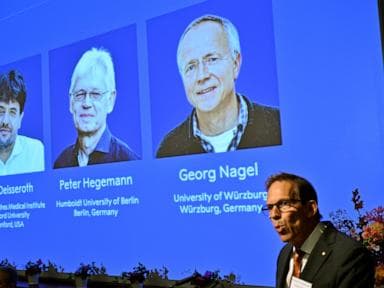
- Karl Deisseroth, Peter Hegemann, and Georg Nagel won the Nobel Prize in Medicine for developing optogenetics.
- The technique uses light-sensitive proteins from algae to turn specific brain cells on and off with millisecond precision.
- The 12 million Swedish kronor prize money will be shared among the three scientists.
OPA WIRE, Oct 6 (OPA) — The 2024 Nobel Prize in Physiology or Medicine was awarded on Monday to Karl Deisseroth, Peter Hegemann, and Georg Nagel for developing optogenetics, a revolutionary technique using light to control cellular activity. The Nobel Assembly at Stockholm's Karolinska Institute recognized the trio for discovering light-gated ion channels and applying them to brain circuitry, ushering in a transformative era for neuroscience.
The scientific breakthrough originated with Hegemann and Nagel in Germany, who identified light-sensitive proteins in green algae that generate electrical impulses upon blue-light exposure. Deisseroth, a professor at Stanford University, subsequently adapted this mechanism into living mammalian brain cells using modified genes and micro-optical fibers. “People usually think about light as a way of collecting information to observe things,” Deisseroth explained. “This is using light to control things, to make things happen, and to do it in a very precise way.”
Operating on millisecond timescales, optogenetics shifted neurological research from static anatomical maps to dynamic, functional circuitry diagrams. Nobel Assembly member Abdel El Manira highlighted that the technology has transformed scientific understanding of both healthy brain operations and disrupted pathways linked to blindness, depression, addiction, and dementia. Jeremy Berg, formerly of the U.S. National Institutes of Health, noted that the methodology provides an unprecedentedly precise experimental toolkit.
The laureates will share the award of 12 million Swedish kronor, roughly equivalent to 1.2 million dollars. Beyond fundamental research, optogenetic principles are currently driving targeted clinical trials, including experimental therapies for retinitis pigmentosa, schizophrenia, and autism. The announcement marks the beginning of Nobel week, with subsequent honors in physics, chemistry, literature, peace, and economic sciences scheduled across the coming days.
Subscribe to the Global Briefing
Receive our flagship executive dispatch every morning. Essential geopolitical analysis, financial benchmarks, and breaking world events delivered to your inbox.
Mohammad Karamali
Verified Wire ContributorSenior correspondent covering geopolitics, regional developments, and strategic international affairs for OPA News (Optimum Public Affairs).
Related Stories & Follow-ups
Editorial Wire


Reader Discussion
Leave a Comment
0 Comments
Owner
Editorial Oversight & Machine-Assisted Reporting
Human-in-the-Loop VerifiedEditorial Oversight & Machine-Assisted Reporting: This dispatch was synthesized and localized via OPA automated intelligence under continuous human editorial supervision.
Wire Source
This report was synthesized from ABC under journalistic fair use.