
Nobel Physics Prize Awarded to Francis Halzen for IceCube Neutrino Discoveries
Key Takeaways
- Francis Halzen received the Nobel Prize in Physics for his foundational work on the IceCube Neutrino Observatory.
- The IceCube collaboration spans roughly 450 scientists across 58 institutions and 14 countries operating at the South Pole.
- The 2025 prize includes a cash award of 12 million Swedish kronor (approximately $1.2 million).
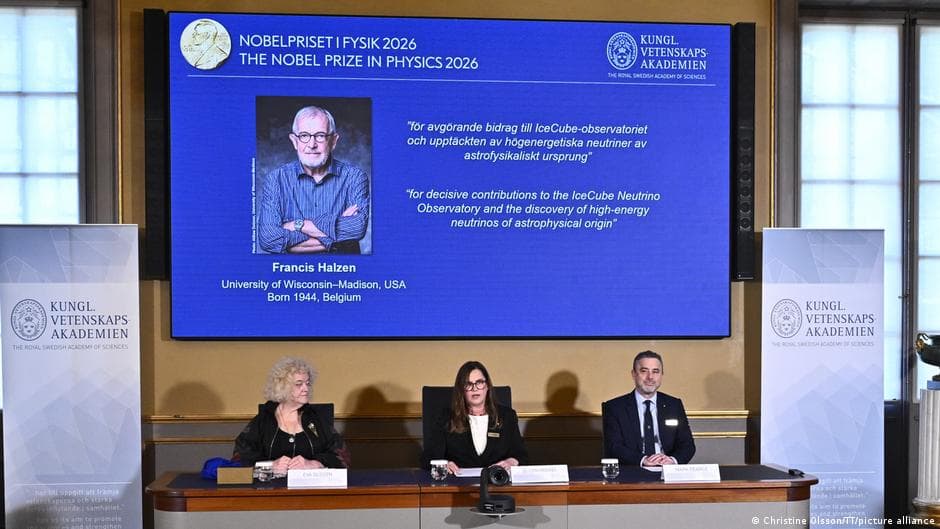
OPA WIRE, Oct 6 (OPA) — The Royal Swedish Academy of Sciences on Tuesday awarded the Nobel Prize in Physics to Francis Halzen for his decisive contributions to the IceCube Neutrino Observatory and the discovery of high-energy neutrinos originating from astrophysical sources. The committee characterized these elusive subatomic particles as "ghostly messages from space." Halzen, an 82-year-old Belgian-born researcher, serves as a physics professor at the University of Wisconsin–Madison in the United States.
Reacting to the announcement, Halzen expressed surprise and emphasized the collaborative effort and fortune required to bring the massive project to fruition. "This was kind of an adventure, where success was not guaranteed. It was a long journey, but it finally worked," Halzen stated, adding that he hoped the accolade recognized the "really courageous people" who joined an effort that more conservative physicists initially shunned. The award carries a purse of 12 million Swedish kronor, equivalent to roughly $1.2 million.
Neutrinos are fundamental particles with infinitesimally small mass that permeate the universe, with trillions passing through human bodies every second. Because direct observation of these "ghost particles" is impossible, researchers detect them via interactions that occur when they collide with matter. Halzen conceived the concept of constructing a massive detector buried deep within the Antarctic ice sheet at the South Pole during the 1980s, eventually establishing IceCube as a premier research facility operated by approximately 450 physicists across 58 institutions in 14 nations.
The data gathered by the observatory provides critical insight into cosmic phenomena, acting as fingerprints of extreme astrophysical environments while helping researchers probe unresolved dilemmas in modern physics, such as the composition of dark matter. Halzen's recognition represents the 119th time the physics prize has been bestowed since 1901, following the announcement of the Nobel Prize in Medicine earlier in the week.
Subscribe to the Global Briefing
Receive our flagship executive dispatch every morning. Essential geopolitical analysis, financial benchmarks, and breaking world events delivered to your inbox.
Mohammad Karamali
Verified Wire ContributorSenior correspondent covering geopolitics, regional developments, and strategic international affairs for OPA News (Optimum Public Affairs).
Related Stories & Follow-ups
Editorial Wire


Reader Discussion
Leave a Comment
0 Comments
Owner
Editorial Oversight & Machine-Assisted Reporting
Human-in-the-Loop VerifiedEditorial Oversight & Machine-Assisted Reporting: This dispatch was synthesized and localized via OPA automated intelligence under continuous human editorial supervision.
Wire Source
This report was synthesized from DW English under journalistic fair use.