
Spanish Wind Sled to Traverse Antarctica in Zero-Emission Scientific Expedition
Key Takeaways
- The Wind Sled uses wind-powered kites and solar energy to eliminate fossil fuel reliance during a 3,400km Antarctic crossing.
- The expedition will conduct 16 scientific projects, including NASA-led research on microbial life and climate change indicators.
- The crew will participate in a psychological study to simulate the isolation challenges of future long-duration space missions.
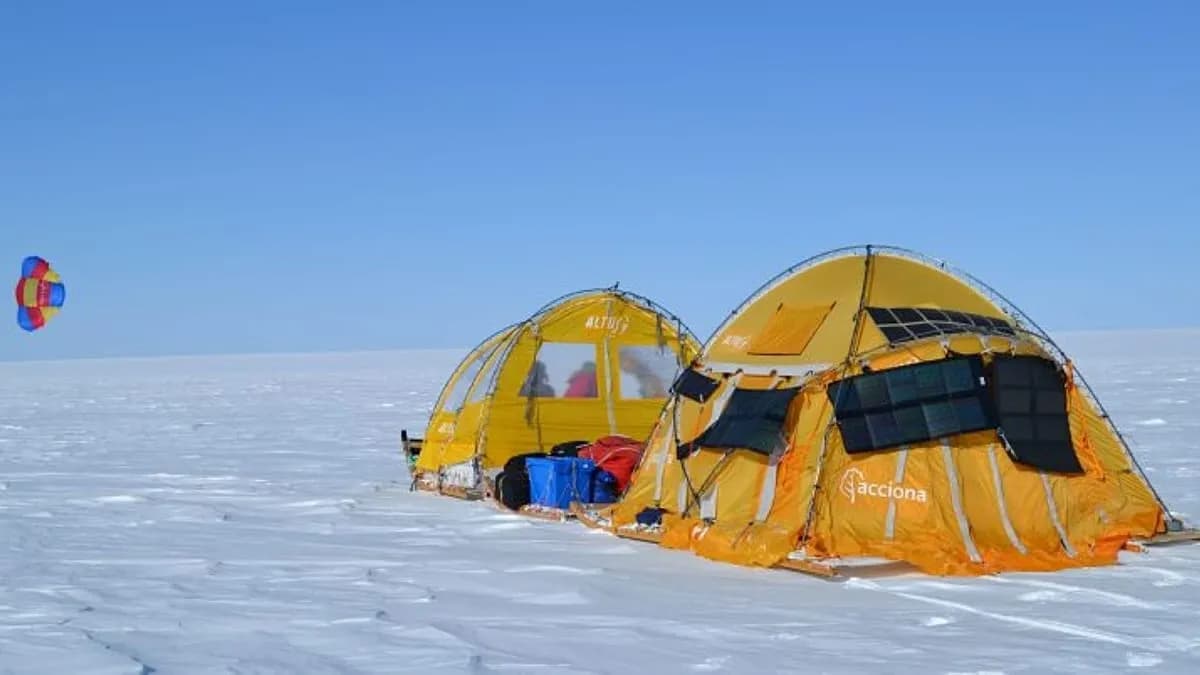
Spanish polar explorer Ramón Larramendi is set to lead the Wind Sled Antarctica 2026-2027 expedition, a 3,400-kilometre journey across the Antarctic interior powered entirely by wind and solar energy. Departing on October 18, the four-person team will spend approximately 80 days traversing some of the planet's most inaccessible regions, including the Pole of Inaccessibility and the Pole of Cold, without relying on fossil fuels or aerial resupply. This mission aims to demonstrate that sustainable exploration is possible in one of the world's harshest environments.
The Wind Sled, a 15-metre, four-module vehicle inspired by Inuit design, utilizes kites to harness wind power, reaching speeds of up to 80 kilometres per hour. Unlike traditional expeditions that consume massive quantities of fuel—such as the 2011-2012 mission that required 170,000 litres—this platform offers a near-zero carbon footprint. Larramendi describes the sled as a unique, highly efficient hybrid of traditional techniques and modern technology, capable of carrying over 2,100 kilos of cargo, though it will initially transport 250 kilos of specialized scientific instruments.
The expedition will facilitate 16 distinct research projects involving international organizations, including NASA. Studies will range from analyzing microbial life in salt rocks and measuring snow accumulation to investigating microplastics and Earth's magnetism. By operating in data-scarce regions, the team will provide critical information to complement satellite observations, helping scientists better understand climate change, ice mass evolution, and the presence of pollutants in polar ecosystems.
Beyond environmental research, the crew will serve as subjects for the 'WindSled Mind' project, which examines the psychological effects of 85 days of isolation. This study aims to provide data applicable to future long-duration space missions, where astronauts will face similar confinement and extreme conditions. By testing both equipment and human resilience in Antarctica, the project positions itself as a vital precursor for future planetary exploration, proving that self-sufficiency and sustainability are the keys to unlocking the secrets of the world's most remote frontiers.
Related Stories


Reader Discussion
Leave a Comment
0 Comments
Owner
Editorial Oversight & Machine-Assisted Reporting
Human-in-the-Loop VerifiedEditorial Oversight & Machine-Assisted Reporting: This dispatch was synthesized and localized via OPA automated intelligence under continuous human editorial supervision.
Wire Source
This report was synthesized from Euro News under journalistic fair use.