
Voyager 1 reaches 25.9 billion kilometres from Earth, maintaining operations after 50 years
Key Takeaways
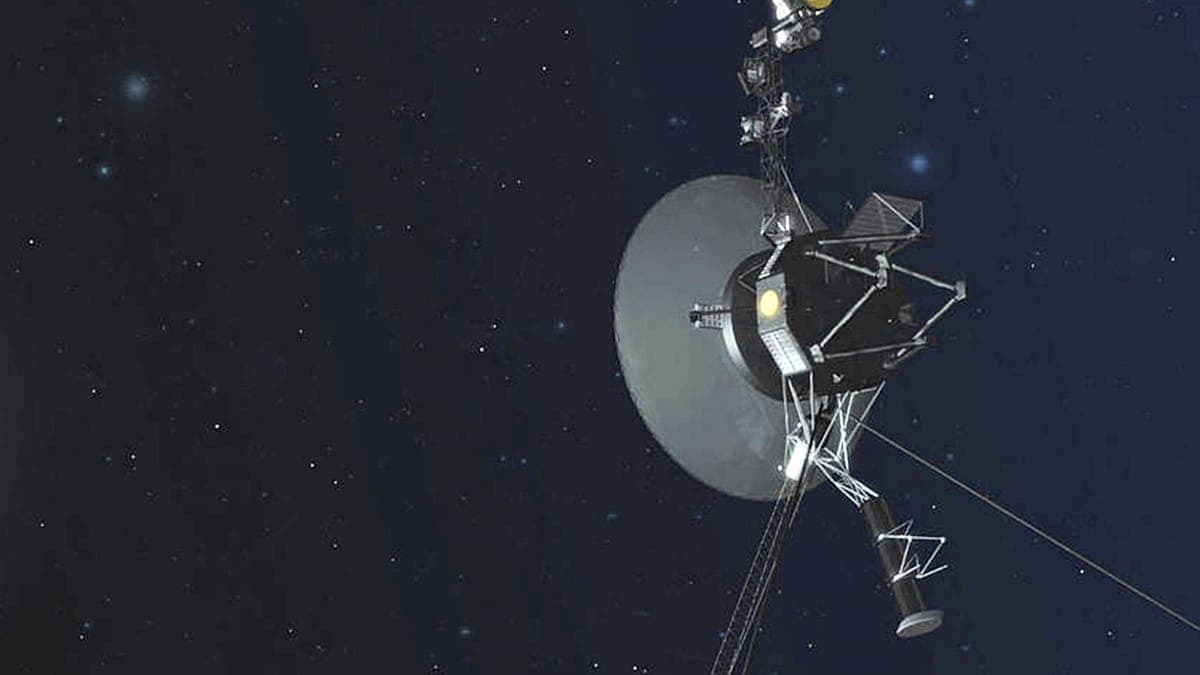
- Voyager 1 is currently 25.9 billion kilometres from Earth, traveling at approximately 61,000 km/h.
- The spacecraft launched on September 5, 1977, and crossed into interstellar space in August 2012.
- NASA shut down an additional scientific instrument in April 2026 due to declining plutonium power reserves.
OPA WIRE, Nov 18 (OPA) — Launched on September 5, 1977, from the Cape Canaveral Space Center in Florida aboard a Titan IIIE-Centaur rocket, Voyager 1 surpassed its twin probe, Voyager 2. Utilizing gravitational assists from Jupiter in March 1979 and Saturn in November 1980, the spacecraft accelerated to roughly 61,000 kilometres per hour, or 17 kilometres per second. In August 2012, it crossed the heliopause to become the first human-built object to enter interstellar space.
Operating nearly half a century later, the probe faces multiple technological and power constraints driven by the radioactive decay of its plutonium power source. NASA engineers resolved a computer memory malfunction in late 2023 and addressed clogged thruster pipes in 2024 by switching antenna-pointing systems. To conserve dwindling energy supplies, mission controllers shut down an additional scientific instrument in April 2026, though functional systems continue sending telemetry back to Earth.
Onboard the spacecraft sits a 30-centimetre golden record conceived by astronomer Carl Sagan and other scientists. Designed as an interstellar message for potential extraterrestrial civilizations, the record contains 115 images, greetings in 55 languages, environmental sounds, music ranging from Bach to Chuck Berry, and a recorded message from then-US President Jimmy Carter.
Voyager 1 now travels through interstellar space toward the Oort Cloud, a distant reservoir of comets surrounding the solar system. NASA estimates the probe will reach the inner edge of the Oort Cloud in roughly 300 years and take up to 30,000 years to exit it entirely. In approximately 40,000 years, the silent spacecraft will pass within 1.7 light-years of the red dwarf star Gliese 445 in the constellation Camelopardalis before eventually losing all transmitter power and drifting through the galaxy indefinitely.
Subscribe to the Global Briefing
Receive our flagship executive dispatch every morning. Essential geopolitical analysis, financial benchmarks, and breaking world events delivered to your inbox.
Mohammad Karamali
Verified Wire ContributorSenior correspondent covering geopolitics, regional developments, and strategic international affairs for OPA News (Optimum Public Affairs).
Related Stories & Follow-ups
Editorial Wire

Reader Discussion
Leave a Comment
0 Comments
Owner
Editorial Oversight & Machine-Assisted Reporting
Human-in-the-Loop VerifiedEditorial Oversight & Machine-Assisted Reporting: This dispatch was synthesized and localized via OPA automated intelligence under continuous human editorial supervision.
Wire Source
This report was synthesized from Euro News under journalistic fair use.